Showing posts with label history. Show all posts

Thursday, November 28, 2013

Happy Thanksgiving to All US Americans

0 comments

This is for all US Americans regardless of where you live, Happy Thanksgiving. Our other American friends, the Canadians celebrated their Thanksgiving holiday in October.

If you need any last minute assistance, perhaps this will guide you along the way.

I will be preparing the pumpkin and apple desserts today for our holiday gathering tomorrow. 

Here are a few history lessons regarding the holiday.

How FDR changed Thanksgiving. 
Thanksgiving from the History Channel.


Enhanced by Zemanta

Pin It Now!

Tuesday, December 23, 2008

The Importance of Meeting Ernst - Melbourne

0 comments

Before we left Budapest, Ron had booked a free walking tour with the city of Melbourne, a service they provide through their tourism office. We were scheduled to meet our tour leader at 9:30, so we were up early with plans to have breakfast closer to Federation Square, the initial spot. The suburban train station is less than a minute from our hotel. The weather looked iffy as we approached the station; it was not just chilly, but downright cold. Neither of us had brought along a jacket, thinking this is summertime. Within ten minutes, we both regretted it, but did not want to miss the train for a quick run back to the hotel to play fetch. Reason told us that this was only early morning chill and the day would warm after an hour or more. On the platform, there is an intercom box, which by pressing the green button, it will announce the next train to stop at that station and the approximated number of minutes to wait. We had a fifteen minute lag time, but it deposited us right across the street from the tourism office, giving us time for a coffee at the nearby café. Federation Square directly across from the train station, is for the most part an open area where large crowds can gather comfortably. The two notable buildings are ultra-modern and look like they have been the result of war wreckage. The open area is constructed in reddish-brown sand color bricks of various hues, bringing to mind the Australian outback. Different areas are elevated by steps, giving crowds of people different levels for viewing. In some areas, these desert multi-colored rectangles give the sensation of undulating sand dunes as you leave civilization preparing for the harsh realities of the outback with its unforgiving forces of nature. Seated in one corner of the Square is a glass house, where the tourism center is located, but first one must go downstairs. The expansive space is well designed for efficiency, yet there is an immediate sense of welcoming at the same time. Once you take a number, you wait for the next available volunteer to call you. Most of the people milling around serving visitors are volunteers, not paid workers. As a number is called, a melodious voice announces “Number 34, please go to counter number 8”. While I was wandering around, deciding if I should buy a sweatshirt or not, Ron had found our tour guide. I only found sweaters that were selling for $160., so the chill seemed more acceptable with every dollar. Our tour guide's name was Ernst, but insisted on being called Ernie. He was originally from Germany, but came over as a youth, and has lived in Australia for fifty-six years. Immediately after introductions, Ernst shared that he was seventy-one years old, swears a lot, but will try to hold back if we are offended by it, and that he has a tendency to touch when he speaks. After reassuring him that these were not problems for us, he went on to say that a German woman he toured yesterday, told him off for touching her shoulder. Ernst gives young-elderly new meaning. He has spring in his step, he is feisty, and continues to contribute to his society. Two woman were supposed to be part of our tour, but they did not show. Their loss, we had Ernst all to ourselves. To try to recall a fraction of what Ernst shared with us starting in Federation Square and continuing for the next four hours, could not do anyone justice. Ernst's prior vocation before retirement was as a teacher in a vocational college, but he retired at fifty-three years old. His love for talking is apparent, but not abusive. He was continually alert when sensing we had questions and he was sensitive to our needs and interests. Honestly, it was only toward the end of the four hours that I started getting weary and I blame myself for this. Thinking I may have a chance to get some writing in during the day, I had my computer in my side bag. Add to that a thick wallet and a large digital camera and even if the computer is only two pounds, it gets tiring. A couple of things immediately stick out in my mind about what Ernst had told us that I will share. One Aborigine language uses the word euro for kangaroo, so Ernst has told his relatives in Germany that Australia had Euros for thousands of years before Europe ever thought about it. There were over four hundred different Aborigine tribes throughout Australia, all with different languages and cultures. Prior to the white man, there were no horses or camels to facilitate travel or communication, thus keeping the different tribes independent and separated culturally and linguistically. With hunting Aborigines, the introduction of diseases, and other conquering hero tactics, the Aborigines have almost been decimated. It was only the current Prime Minister who has apologized for their demise; the last one refused to say “Sorry”, but he was a Bush supporting ass, so it figures. Ernie heard us when we said we were interested in architecture. He took us to see impressive buildings including historic banks and the stock exchange. His thorough knowledge of the city is impressive considering he himself does not live within the city, but commutes in for tours. Every three months, he travels to some other part of the country or to other countries, so he is attuned to a traveler's needs. By the time we were to say good-bye, we had passed our tour time by thirty minutes. We stopped at a café to fill out his 'quality assurance' survey. Ernie had advised us to visit the State Library to see the dome. We had to check our bags into computerized lockers, but it was worth the effort. I have yet to see a library like this before, even in the States, and I have been to over thirty states. Computers were everywhere with a fifteen minute time limit for use on one side with a line of people waiting. On the other were just as many computers with access to the contents of the library's collection. In the center of the room, the vaulted ceiling was four stories up ending in a superb dome, which was the main attraction Ernie had in mind. However, it was not the dome that impressed me the most, but the arcade on each floor above the first floor. Each floor had floor to ceiling bookshelves with volumes filling them. These looked to be classic collections or other rare books by the looks of the bindings. Behind each of these balconies were galleries of art work or other exhibitions. The one we spent a couple of hours with was the history of the printed word. They did such a beautiful and comprehensive display, which I could have spent another two hours investigating, but I could feel Ron's need to move on elsewhere. We kept verbally promising each other that 'right after....' we will return to the hotel and get our coats. It never did get too much warmer. When in the sun, it was fine, but once in th shade or shadows of stores or other buildings, the wind snapped at you with a fierce blow of cold air. As we passed a Starbucks, I did not so much as have a need for a coffee, but rather the hope of Internet. Remembering that in Malaysia, every Starbucks was a provider of free WiFi Internet, I was hoping it was the same here too. Sadly, not! Yes, they did have WiFi, but the staff did not seem to understand the word FREE. They kept insisting all I needed to do was open my web browser and create my own ID and password, yet to do this, you first had to buy time. They did not get it, it was not as free as they were led to believe. Biting the bullet, I bought time. The reason I was reluctant is because, if I have to buy it each place we go, it is not transferable from one place to the other. Use it or lose it. Use too much and be left wanting more. The usual routine of life. Aside from that, considering in Budapest, you can find free WiFi everywhere you turn, it irks me to have to pay for it in major cities in developed first world countries, not to mention airports in cities like Amsterdam. So breaking our promise again, we went back to the tourism office for more information. Tonight at 9:00, there will be a show on Federation Square where they will uncover the next number in the giant Advent calendar. We found we missed the free rehearsal of the Christmas carolers, but we were in luck to visit the famous Myers Department Store, where they are famous for their extravagant Christmas displays. The line for viewing the windows was over a block long, but well organized with chains giving everyone a fair chance. Once at the first window, no one rushed anyone along, so you could spend as much time gawking, oohing and aahing as you wished. The theme was “How Santa Really Works”, based on a children's book by the same name. Each of the windows was jammed with a visual moving representations of the book. Although we have not read the book, we are guessing that the thought bubbles above the characters heads in the windows are text from the book also. It took us about forty minutes to get through the line, but another fifteen or more to appreciate all of the intricacies to make this window such a celebrated attraction. We had heard the store David Jones had “Santa's Cave” so in line with getting Christmas spirit, we went in search of this cave. Not being into spelunking, we were a bit cautious of what we might find, but like Indiana Jones, we were in search of adventure. There just happens to be a trilogy of David Jones stores within blocks of each other, each only holding one part of the stores' selections. Naturally, on the third try, we found the one where Santa was hiding out in cave-like splendor. Why Santa would be associated with something as sinister sounding as a cave was beyond my getting answers. By passing the snickering elves that wisely perceived we were adults without children, coming to investigate the goings on here, we were disappointed to realize that David Jones is no Myer's Department Store where the spirit of Christmas is concerned. This Scrooge has set up a commercially profitable little business to capitalize on Santa's good name and reputation. While waiting in line for Santa, mommy and daddy can buy the little ones treats like popcorn, candy bars, or “fairy floss” (cotton candy). After they get the sugar rush, you can buy them a ticket to ride the mini-merry-go-round with the choice of three horses that look like something from Gulliver's Travels land of the little people. It was with firm resolve at this point that we were determined to return to the hotel for coats. Ron discovered that the 109 tram ran close to where we laid ourself to sleep last night, so we picked up our coats and were back out again in record time. Earlier we had discovered a Crispy Crème donut shop. I insisted we return for dessert before dinner. On Federation Square, there is hangs a humongous Advent calendar along the side walls of a building. My guess is that the building is 12 stories, but it could be larger. At 9:00 each night, there is a show where they remove one of the numbers from the calendar. We were there at 9:00 to see the proceedings, but we were not ready for what happened next. From the top of the building, a clown is dropped like a bungee jumper. With a spotlight on him, he does acrobatics in the air and against the wall. As this is happening, different lights appear behind him shaped like bursting stars or fireworks. This part of the show continues for about ten minutes when the other side of the blue screen and Advent boxes light up. Another clown appears and starts performing also. The difference is that this clown has a movie projected on the blue background giving him scenery to interact with. As the scenery moves, this clown who is suspended stories from the top of the building walks down a street, looks into store windows, climbs a telephone pole or rides a scooter. Finally, he systematically removes the ribbon of the present du jour and then proceeds to take of f the wrapping exposing the next number. After forty-five minutes, the performance is over. Each night the participants are eligible to submit their names into a drawing for a new mobile phone. The winner is announced at the end of the show. One of the buildings on Federation Square is related to film. Outside of their building, there are three oversized presents. In one of the presents is a television with a scrolling display of the holidays in December and how they are celebrated in different parts of the world. Ernie had told us that Melbourne has the largest Greek population outside of Athens and Chicago. He said that there are over 150 languages spoken in the city and for the most part, have reached racial and ethnic harmony. To further illustrate this point, the large video advertisement in the square has Merry Christmas alternating through a number of different languages with the associated flag from that country. Finally, but 10:00 pm, we thought we better take the tram to scope out the area to see what the offerings would be for dinner. As we were standing at the tram stop, I noticed a stand in the train station called Lord of the Fries, which caused me to guffaw and mention it to Ron. This little pixie woman of about twenty-two years of life responded with the fact that they offerings were not bad at all, but a little overpriced. After a minute, she started in asking if we were on vacation, et cetera. We headed in two different directions when the tram doors opened, so it was magical to find her by my side when I looked up. She picked up the conversation where we left off as if there we were still conversing when we parted company. When we decided to get off two stops later after seeing a couple of restaurants open, she detrammed along with us all the while giving me restaurant reviews. We stood in the street still discussing the merits of each establishment, but she wisely suggested we step up to the curb. I was still a bit overwhelmed by the fact that she was still by my side. I was not sure if she was waiting for a dinner invite or an invitation to come stay with us. After profusely thanking her for her assistance and sage advise, we parted ways.

Pin It Now!

Sunday, July 02, 2006

Statue Park: Szoborpark

0 comments

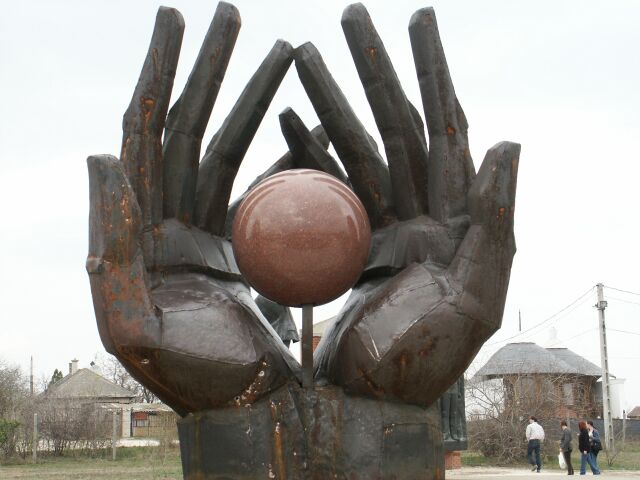
Statue Park (Szoborpark) is an open air museum that I have done in the past. As the expression goes, “Been there, done that”. Therefore, I have no desire to do it again even if personal guests begged me. It is located in the

Back then, the statues represented, albeit superficially, a powerful symbol of Soviet strength and unity. Today, stuck out on the edge of town, they've lost much of their dignity, instead being brutally exposed as the idealistic follies that ordinary Hungarians always knew them to be. Worth a look, but not as impressive as most guidebooks would have you believe.”

For myself, some of the statues are impressive as pieces of art, but as the emotional symbols they are meant to infuse, the feelings are long gone. The park is a large fort like area that reminds me of the old Wild West towns in the US used to ‘recreate’ the feelings of the wild frontier.

When you enter and the cheesy Soviet music starts, you are consumed with a creepy feeling. The inside of the park is a stark rectangle with the statues running along the perimeter of the fence. Other than the wording on the individual statues if there is any, there is nothing to read in any language, no description of the statues, its purpose, or
history. At the time we went, which admittedly was four years ago, it took us a strained 45 minutes to look at the statues, take pictures, and take pictures yet again to waste time until the bus returning to the city would be available to pick us up yet again.

This is one site we never recommend to visitors unless they are staying in Budapest for more than seven days and have done everything else including counting the number of times a pooper-scooper could have been used on the streets within each district. No stars for this one.

Reblog this post [with Zemanta]

Pin It Now!

Wednesday, June 28, 2006

Continuing the Museum Tours

0 comments

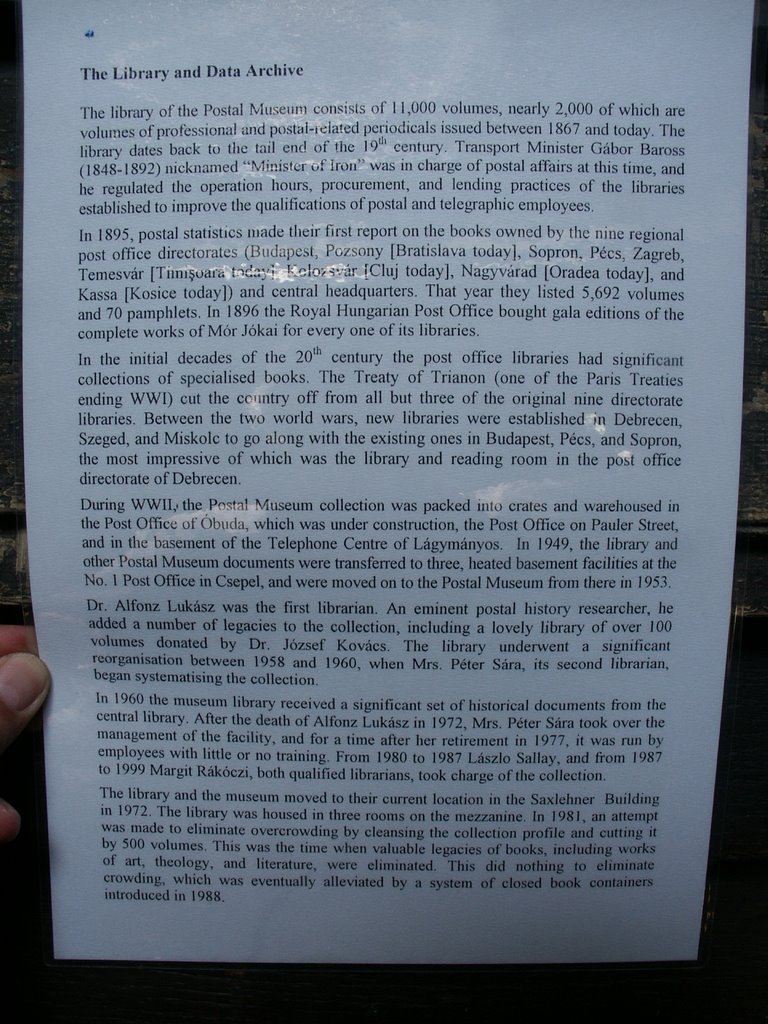
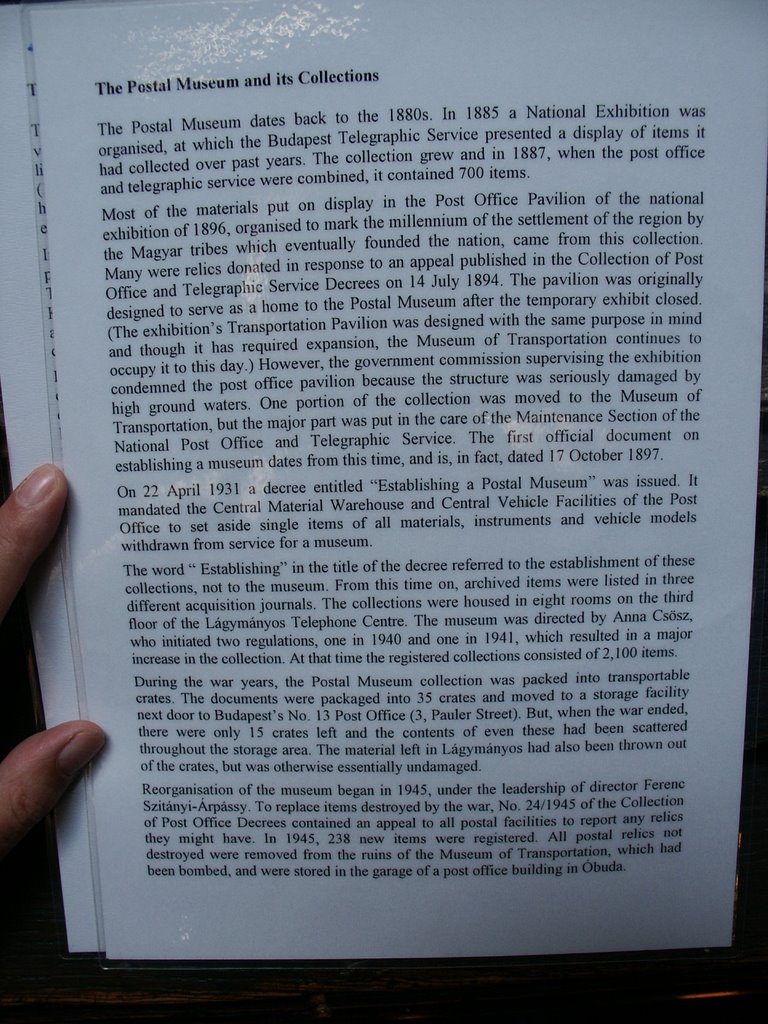
I announced to students that today would start with the Postal Museum at Andrássy út 3, Metro: M1 Bajcsy-Zsilinksky út, Open: 10am-6pm Apr 1-Oct 31, 10am-4pm Nov 1-Mar 31 (closed Mondays).

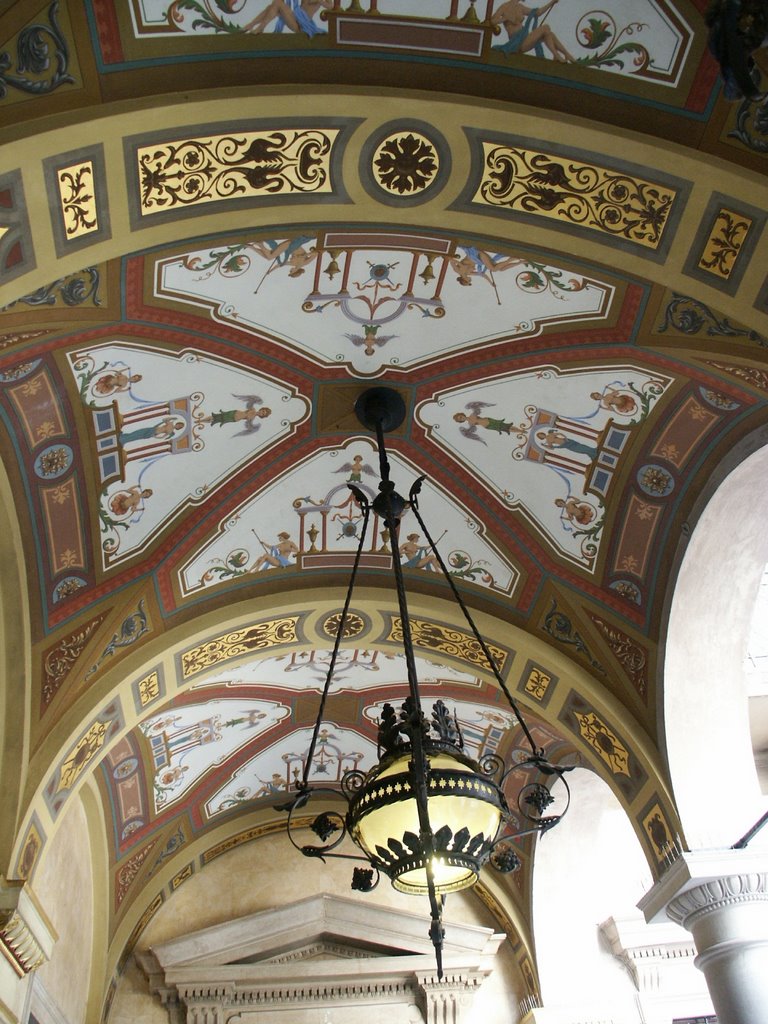
When arriving at this address, one has to press a buzzer to be admitted into the building. The building is worth a visit aside from the museum. The museum itself is situated in a decorative first floor apartment formerly belonging to the wealthy Andreas Saxlehner. The museum focuses on the history of the Hungarian postal service and telephones, but there are no stamps here. Included among the exhibits is a mock 19th-century post office and vintage mail vehicle. The building itself is the highlight of a visit here.

On Sunday the admission is free, other times, it is 200 Huf. Well worth the admission for the apartment alone, this is incredibly decorated in the original style. The courtyard has the best view from the balcony on the opposite side of the museum looking back. I have had many pleasant surprises in museums; some I expected to spend less than 30 minutes in and found myself leaving an hour or more later. This one was no exception. About ten minutes into my lurking around, one of my students showed up. She and I continued to browse the rooms and discuss the items on display. Everything was translated into English on laminated cards in each room. This was a shocker considering the size and cost of admission.

My student and I spent a lot of time with all of the exhibits and this brought about a funny situation. She asked one of the attendants a question that I had asked her. The attendant was proud to answer all questions and then later
said to my student, “Where is your father from?” My student explained that I was not her father, but that I was an American. The assistant was duly impressed with the time and care I spent looking at everything and taking many photos. Sadly, during the entire time we were there, we were the only two visitors to a ratio of five employees. I highly recommend this museum, but if you are interested in stamps, there is yet another museum that specializes in them.

The two of us went to Café Eklectica for a coffee and a chat. It was enjoyable to spend time one on one with a student and get to know her better.

For the next stop, we were to go to the Ernst Museum where another student was waiting for us. The museum was closed since they were redoing the current exhibit, so we decided to continue on to the Hopp Museum of Eastern Asiatic Arts. It is in the VI district at Andrássy út 103, Metro: M1 Bajza utca. Open: 10-4pm Jan 1-Mar 13 (closed Mon), 10am-6pm Mar 14-Dec 31 (closed Mon.). Admission is 400 Huf and a photo ticket was 500 Huf. I wisely decided to wait to see the exhibit before purchasing a ticket and was glad of the decision.

This museum is the collection of works from India and the far east accumulated by Hungarian businessman Ferenc Hopp. By the time of his death in 1919, he had amassed a huge collection. According to the literature, the collection consisted of ancient Buddhist art dating back to the 9/10th centuries and is displayed alongside Japanese, Indian and Tibetan-Nepalese pieces.

From what I saw, at the time of our visit, most everything was Japanese. There was a vast collection of inkboxes, which we did not understand what they were for; the explanation in Hungarian was not clear and there is little in English. Although there were other pieces, almost everything was from Japan, which did not interest me in the least, but the students were fascinated.

The place was blazing hot due
to the weather and signs explained that it was not air conditioned on purpose to keep the humidity at a certain level for the items on display. My sympathy went out to the workers. The museum consists of three rooms, but there is one woman sitting downstairs selling tickets and three attendants upstairs monitoring visitors. On this particular day and time, we were the only visitors. I would only recommend this museum to those who have a fervent love of Asiatic pieces, unless the collection rotates. Even at that, I would be hard-pressed to return.

Reblog this post [with Zemanta]

Pin It Now!

Friday, June 23, 2006

A Few Hundred Demonstrate

0 comments

The next day's news in the Budapest Business Journal.

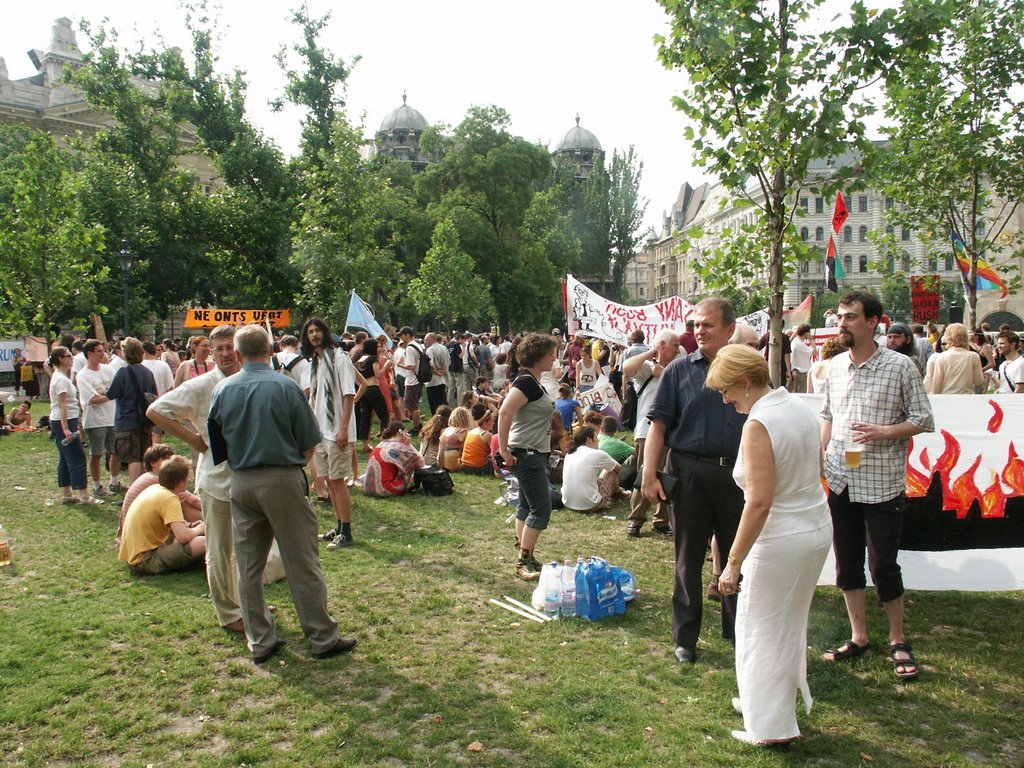
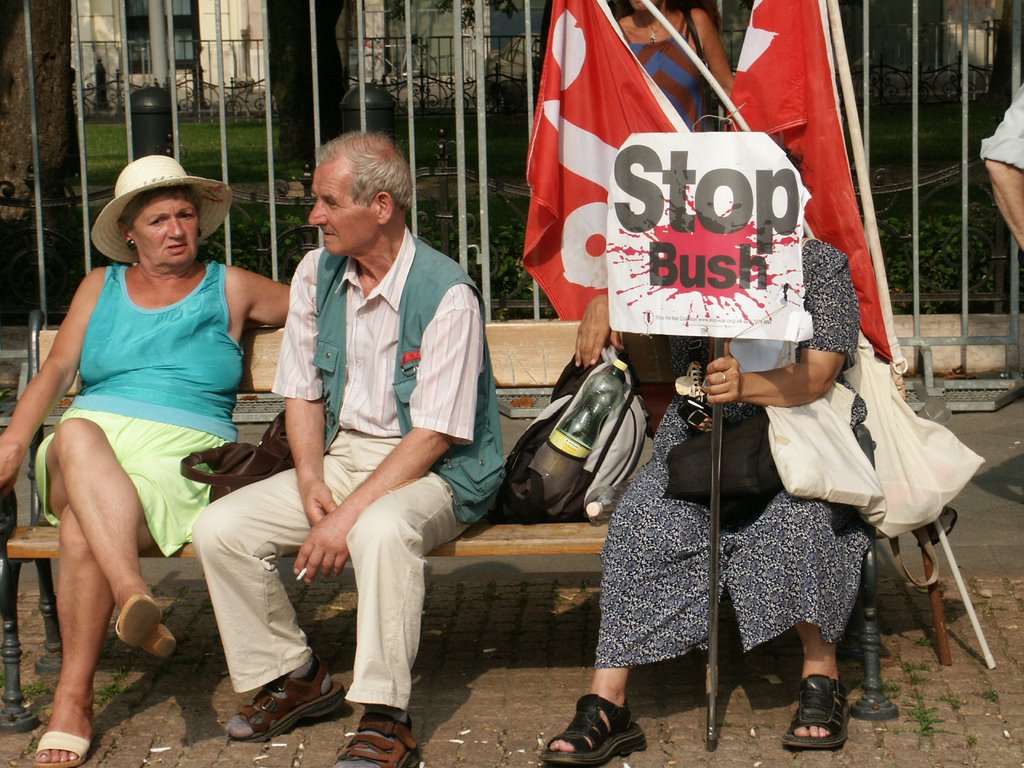
“A few hundred demonstrators gathered in Szabadság tér in front of the US Embassy yesterday afternoon to protest against the visit and policy of US President George W. Bush. Environmental groups Védegylet and Greenpeace were present, along with others such as the anti-globalisation group Attac at the gathering organised by Civilians for Peace.

Philosopher and communist-era dissident Miklós Tamás Gáspár gave the opening speech, asking on what basis Bush speaks out against foreign occupation in regard to 1956, when the US itself is an occupying force elsewhere. He denounced war and murder and spoke up for hope. Earlier, Amnesty International demonstrators in yellow overalls like those worn by inmates of Guantánamo prison were removed from Adam Clark tér before the US President's convoy drove by. “


Photo is my own.


Reblog this post [with Zemanta]

Pin It Now!

Thursday, June 22, 2006

Bush is Here

0 comments

George W. arrived in Budapest today. The preparation has been unreal and the cost to the American taxpayer is astronomical. They had to fly over his special bulletproof cars and there were dozens of costly preparations for his less than 24-hour trip. This morning starting at 7:00 am, the sound of helicopters flying overhead has been non-stop.

He is giving a short speech and then returning home. The occasion is the 50-year
anniversary of the 1956 Revolution against the Russians here in Hungary. His cousin is the current Ambassador, but he is retiring this summer to be replaced with one of George’s former girlfriends from university days. The cousin replaced Laura’s Bush’s best friend who could not give a rip about Hungary. This is not a respected country for diplomacy when they use it for nepotism. There was a rally protesting his visit at 4:00 outside the US Embassy.


Reblog this post [with Zemanta]

Pin It Now!

Sunday, June 18, 2006

Fishermans Bastion and St. Matthias Church

0 comments

As I was wandering from the video store to return some DVDs, it dawned on me that I rarely do some of the touristy things without having friends in tow. Therefore, it is rare that I get to spend the time at any one place that really fulfills me since I am on someone else’s time schedule. This prompted me to stroll to the castle district.

Initially, it seemed I would traipse all over the area and perhaps visit the museum there as I sat on the number 16 bus from Deák. When reaching the top, St. Matthias Church called out to me and that became my destination. First walking all around Fisherman’s Bastion, exploring parts that I had never been before, it occurred to me there were areas where I had never dragged guests due to time constraints. This was my opportunity to reward myself with as much time as I wanted. There was no reason to rush home, no one waiting there for me, no obligations.

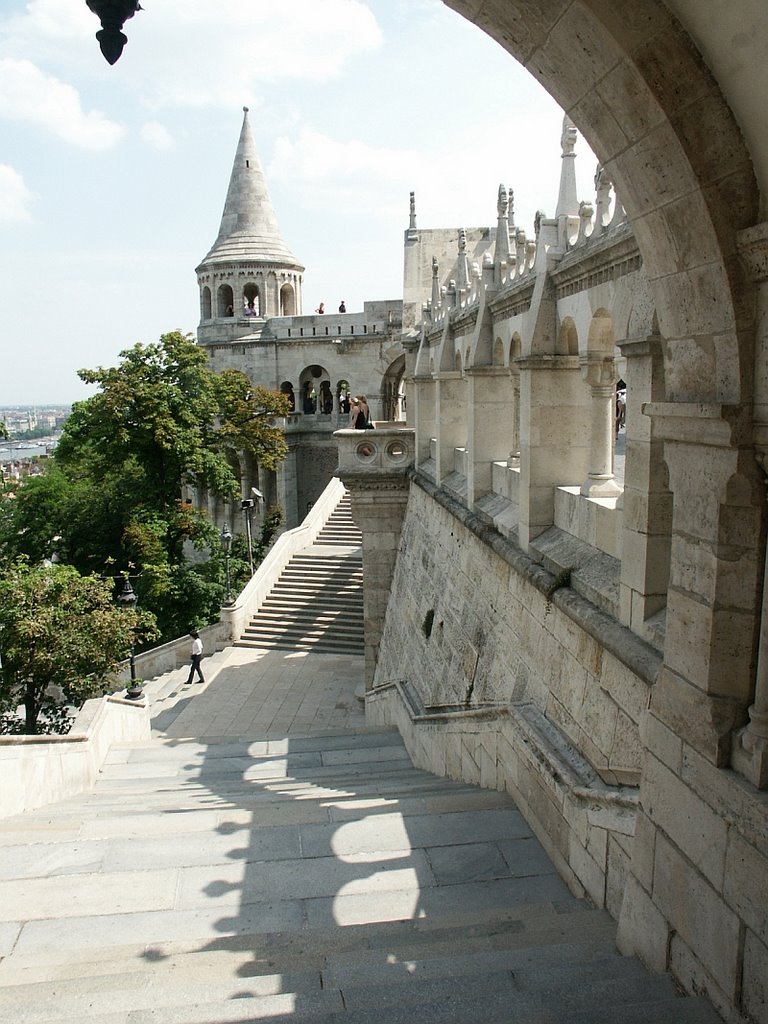
Built in the combined styles of neo-Gothic and neo-Romanesque in 1895, Fisherman's Bastion is a walled terrace built on the Buda side of the Danube on Castle hill. It is behind the St. Matthias Church. It has seven towers that look like castle turrets of fairytales, which represent the seven Magyar tribes that settled in the Carpathian Basin in 896. It earned its name from the guild of fishermen responsible for defending this portion of the city in the Middle Ages. For a fee, you can climb the stairs to view the city from the top, which is said to have a spectacular view. I chose not to spend the money, believing the view from the Citadella was equal or superior to this one.

There are many stairs and walking paths around the area. The view from the free area is just as impressive, though it has been
partially invaded by a restaurant, thus causing obstacles of tables and chairs to climb over to see all views or the purchase of a coffee to have a seat. I was told that the viewing area is free in the evening, which could afford magnificent views when the sun is setting.

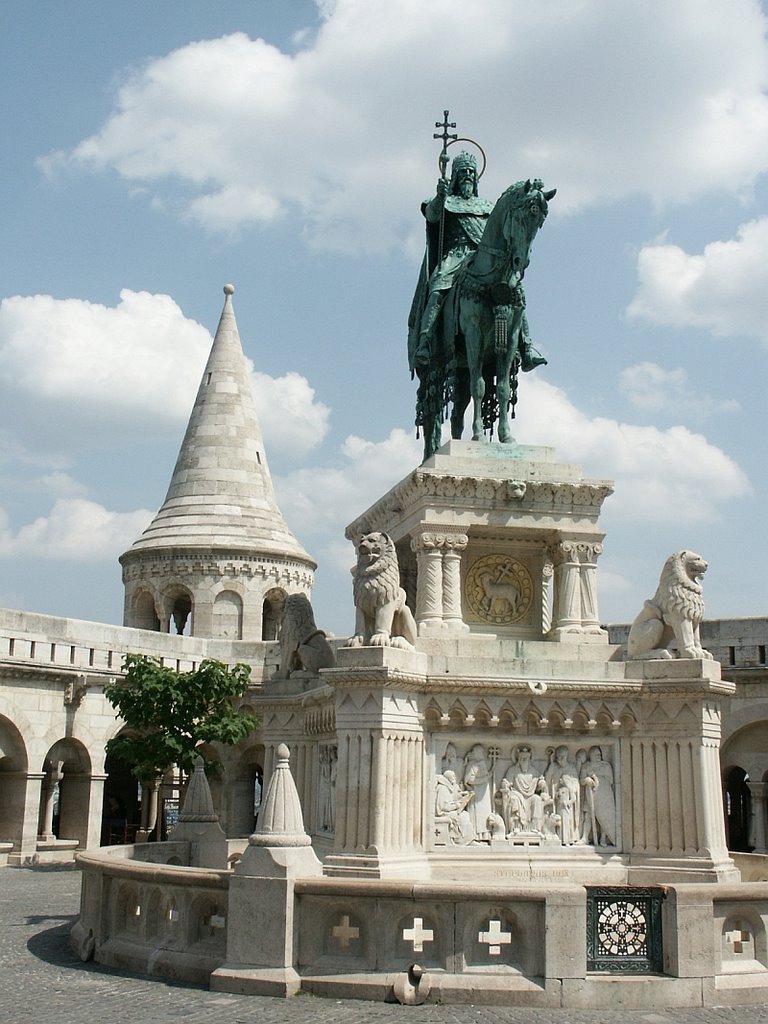
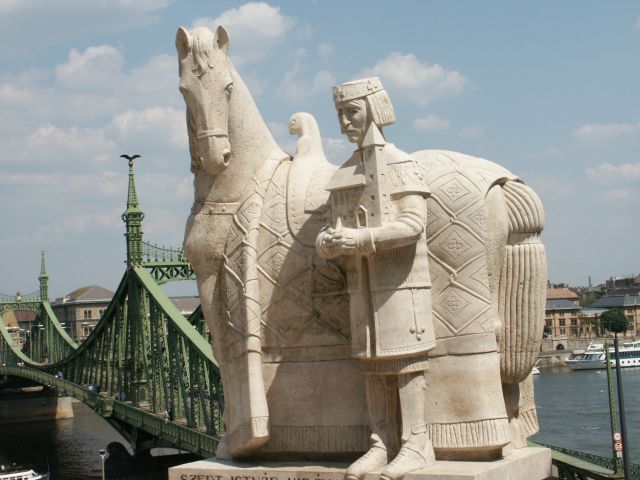
Placed in front of the Bastion is a bronze statue of King St. Stephen I, the first king of a unified Hungary, mounted on a horse. It was erected in 1906. The pedestal was made by Alajos Stróbl, a famous Hungarian sculptor at the turn of the century, known for his realistic modeling. The statue is done in Neo-Romanesque style, with experiences illustrating the King's life.

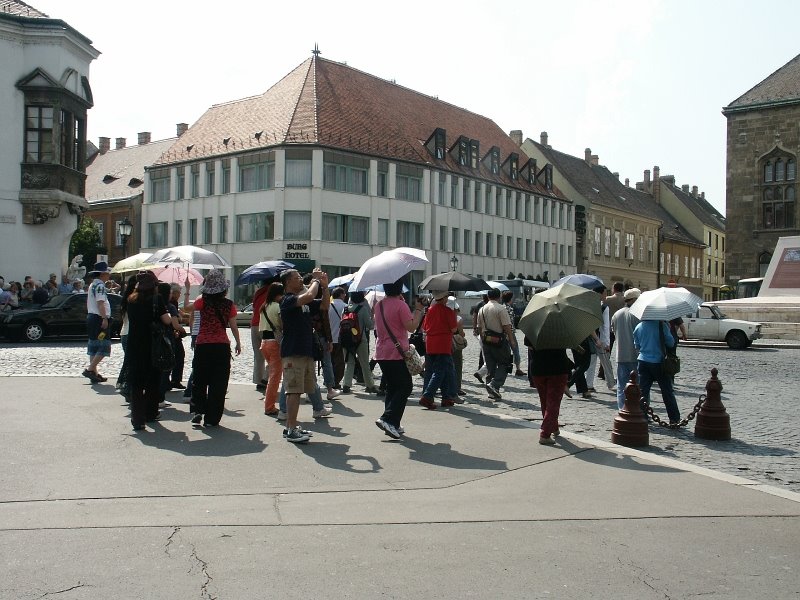
The day was hot and humid, but I refused to allow myself to be gouged 500 Huf for a small bottle water that was four times the price off of the hill. There are water fountains around to quench one’s thirst. The area was filled with tourist groups and commentaries were provided in many languages enriching various nationalities with the history of their surroundings. The group that fascinated me the most was the group of Japanese since they each held an umbrella to protect themselves from the sun. I ambled around, then sat in the shade, and observed people, debating on the righteousness of having to spend 600 Huf to enter St. Matthias Church.

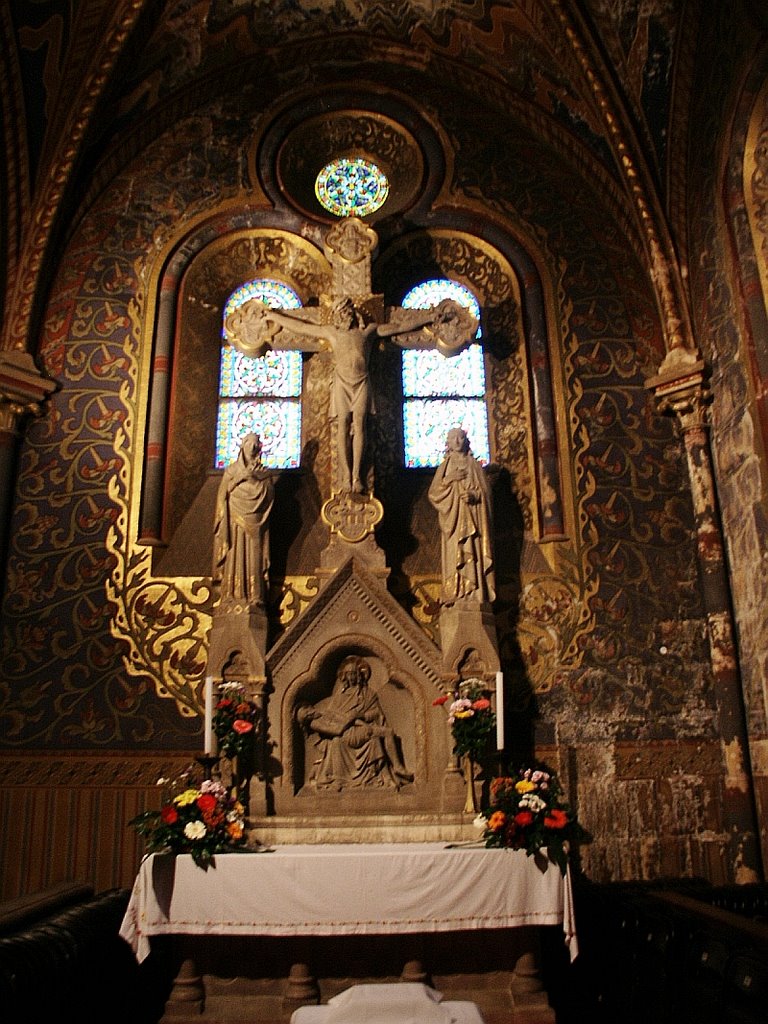
Coming to the realization that this was Sunday and still a small outlay for spending time in a magnificent church that I had only been in once before, I left frugality behind and handed over my cash. Before entering, I found some history of the church written in English. The church is officially called Church of Our Lady. Its popular name is attributed to the greatest Hungarian King Matthias Corvinus ("Matthias the Just") who ordered the construction of its original southern tower. The church was the site for several royal coronations including that of Charles IV in 1916. He was the last of the Hapsburg Kings. It was also where King Mátyás' two wedding were held and King Bela and his queen are entombed there in a chapel. During the Turkish occupation, many of the religious treasures were sent elsewhere and in 1541, the church served as a mosque.

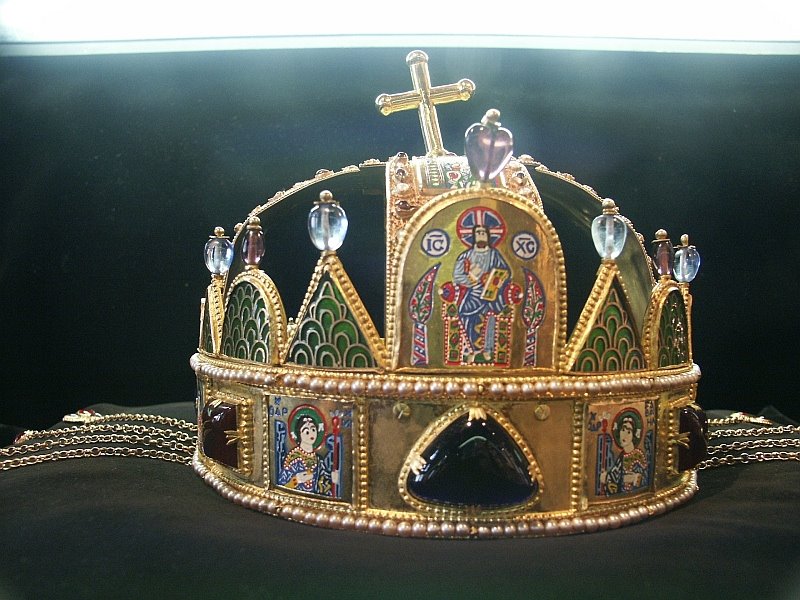
What many people miss is the Ecclesiastical Art museum, which is upstairs starting with a medieval crypt, but leading up to the St. Stephen Chapel. There one will find a gallery containing a number of sacred relics and medieval stone carvings. I especially enjoy the history and the replicas of the Hungarian royal crown and coronation jewels. This was a relaxing duality combination time of being quietly reflective and being a tourist.

By this time, I had spent about four hours meandering this part of castle hill and it had already approached 4:00 pm. It was too late to peruse the castle area, so that part will be saved for another time.

Reblog this post [with Zemanta]

Pin It Now!

Monday, June 05, 2006

Back to Dresden

0 comments

This is a short trip, so we do not have a lot of time for Dresden. We return to Berlin this evening. It is still icy chilly and we need gloves for comfort. Ron insists on making the most of the time, so we walk all over the city and take public transport when necessary.

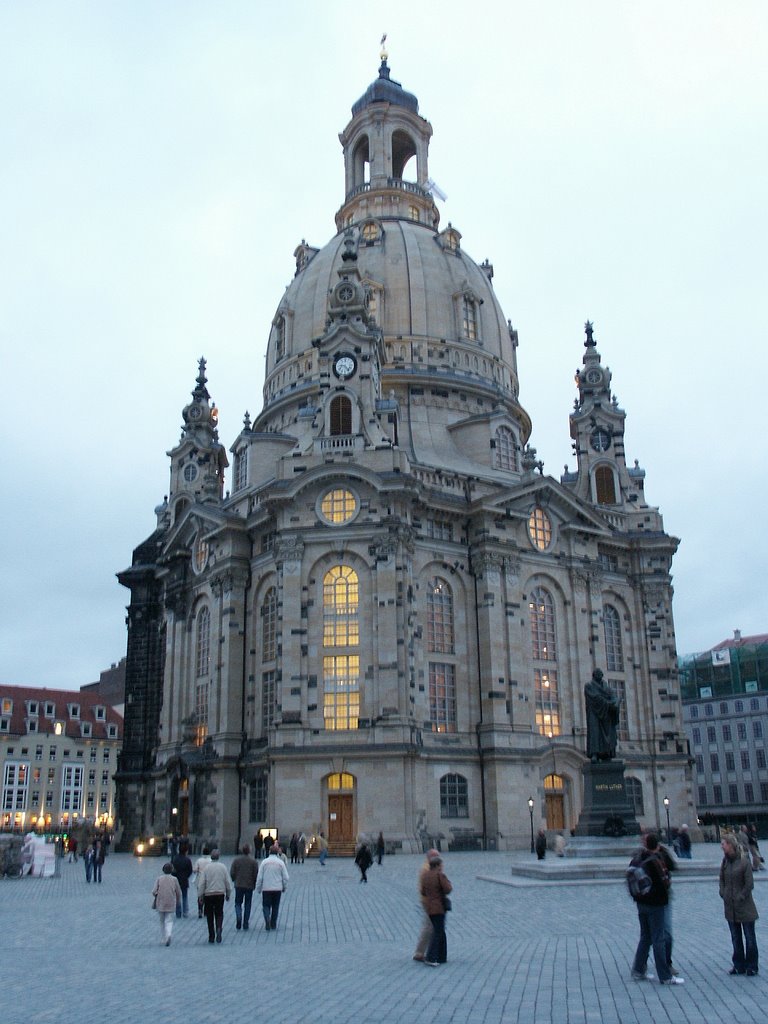
In spite of the bombing in WWII, there are still many highlights in this city. The Baroque Frauenkirche or Church of Our Lady is one of them. It is a Protestant sandstone church built in the 18th century, but was leveled during the war. A 12 year reconstruction project was undertaken at the cost of $160 million to bring it back to its original appearance. This was completed in October 2005. Architects and historians were able to piece together the original bricks that were still useable using archives and photos to put them in their original places. The church looks spotted as a result. The dark fire burned bricks stand out from the new replacement bricks surrounding them, giving the church a sense of resurrection or a phoenix rising from the ashes. Of the original stones, 8,425 were salvaged to be part of the reconstruction.

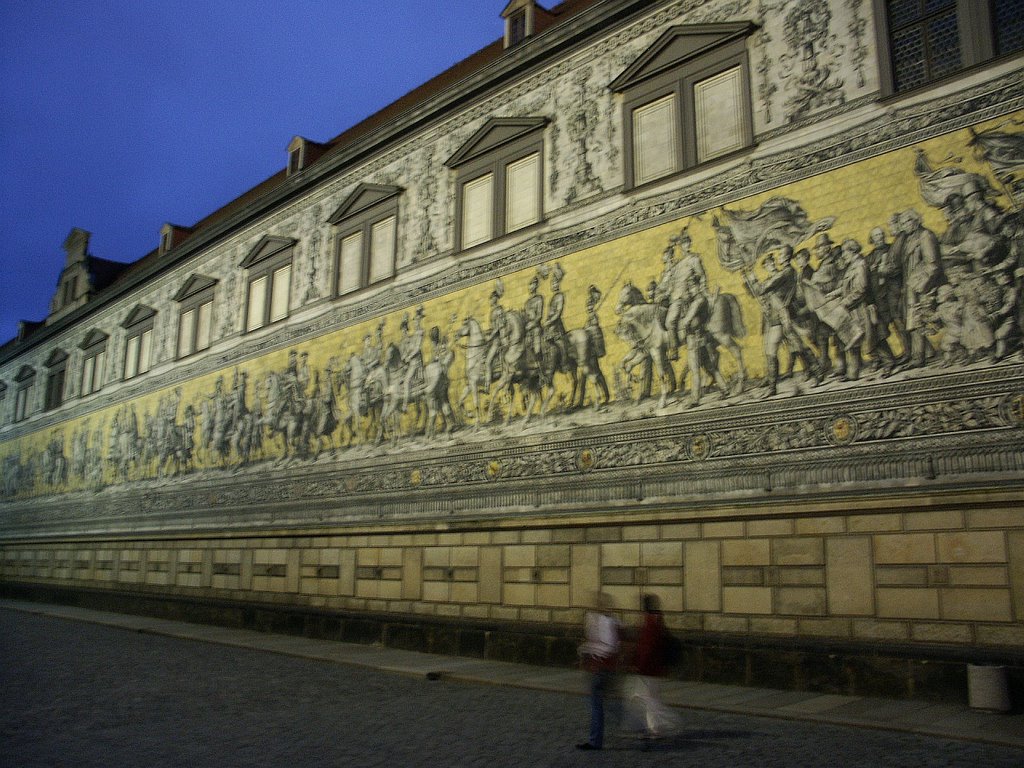
In the same area is a long wall with a 100-meter long porcelain mosaic called Fürstenzug. It is the ‘Procession of the Dukes’ displaying the rulers of Saxony. Nearby is the Semperoper opera house. It was built by Gottfried Semper, thus its name, in the mid-19th century. It is said to be one of Germany's finest examples of neo-renaissance architecture. Fire destroyed it in 1869 and again in 1945. The current building is an exact replica of the original.

The river Elbe runs through the city and divides it in two. We walked over the bridge a few times and enjoyed the views from both sides.


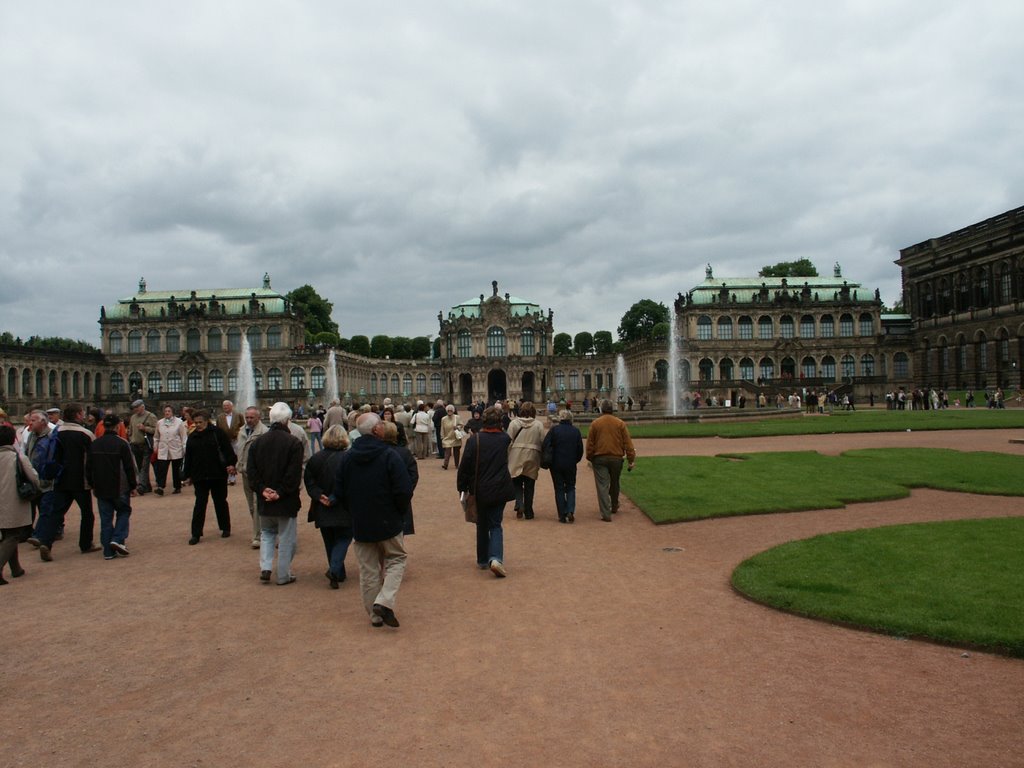
One of the most amazing sights for us was the Zwinger. This amazing complex was
commissioned by Augustus II (the Strong), the elector of Saxony and king of Poland due to his passion for collecting paintings, sculpture, antiquities, but especially porcelain. His collection included 14,500 pieces of porcelain from China and Japan. He established the porcelain factory at Meissen in 1710. Augustus admitted his passion for porcelain was his maladie de porcelaine (porcelain sickness).

Augustus began to build the Zwinger in 1711. It resembles a palace and can easily be mistaken for one. The architect Matthaus Daniel Poppelmann designed it. The Zwinger was destroyed during World War II and partly reconstructed in 1952 and 1963. Now it is fully reconstructed and restored, displaying the famous porcelain collection.

This evening, we take the train back to Berlin.

Reblog this post [with Zemanta]

Pin It Now!

Thursday, May 25, 2006

The Citadella

0 comments

Ron and I wanted to see the photo exhibit at the Citadella, which Patricia and Don had talked about. It is a temporary exhibit called “Children of War”. Though they thought the photography was amazing, they felt horror at the subject matter.

We took two buses to get there and then had to hike up the rest of the hill; only tour buses are allowed at the very top. It was a clear sunny day, making the fresh air jaunt more enjoyable then the time we went in the heat of August. There was a queue of tour buses waiting to park, alerting us that there would be plenty of tourists. The views of the city are
breathtaking from up there, making it a popular place to visit.

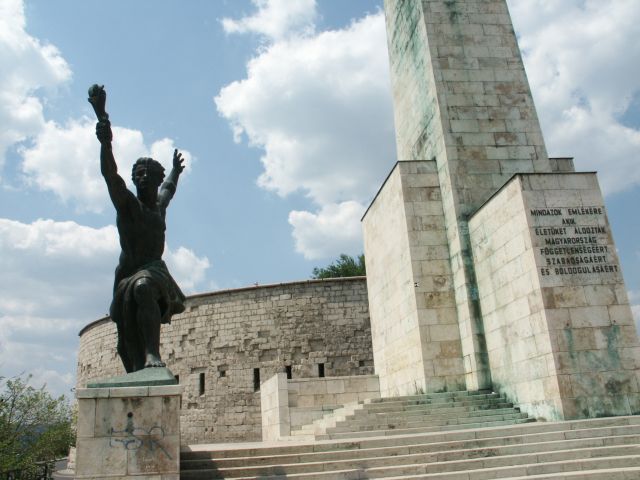
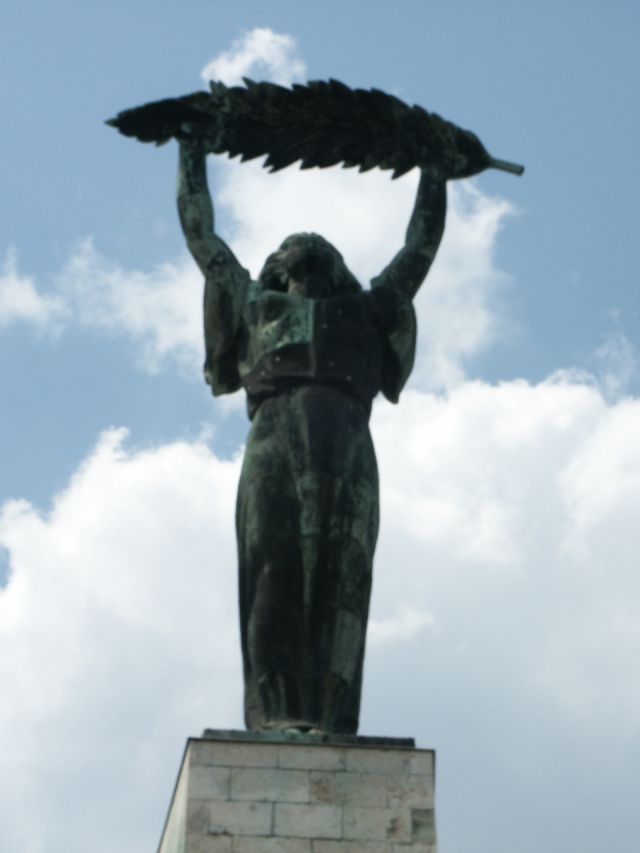
One can walk around quite freely and go to the lower vantage point under the statue of the lady with leaf in her hands, but to go higher and into the exhibit will cost you a bit of cash. According to the brochure given to us after shelling out 1,200 Huf each, we had these things in store for our viewing pleasure:

  • An exhibit of military history with the artillery used by the Soviet army during their siege on Budapest
  • A photo exhibit of Budapest from 1850-1945
  • Waxworks and “Siege of Budapest, 1944” photo exhibit in the air-raid shelter from WWII
  • Photo exhibit in the Hotel Citadella
  • Memorial park showing the life of St. Gellért
  • Exhibit of local history of Mount Gellért
It sounded exciting and enough to fill a half a day, which was a bit worrisome since we had guests coming to our B and B. We did not have that much time. The reality is a bit different.

Our first stop was the photo exhibit. It was in-depth, the photography was amazing and there were explanations in English. Since 1940, there have been 129 wars in the world and over 300 million children have died as a result. The photos covered numerous countries from five continents, not always grouped together. Many had some short explanation. The photos were hung on both sides of the walls in a hallway in the hotel that went in a circular fashion ending where one begins. Since I did not realize this, rather than bounce from side to side, I was going to view one side of the hall and then the
opposite on my return to the entrance. When we found ourselves in the lobby yet again, Ron was too overwhelmed to join me for the other side. It was emotionally draining, so feeling I had seen enough, we just left for the next exhibit.

Walking toward the statue from the hotel and on the left was the local history exhibit of
the Mount Gellért. Four store like display windows protect the exhibit from viewers sticky fingers. What is displayed is mostly geological information, nothing visually stimulating other than a few facts about the Celts and Romans who once occupied the area.
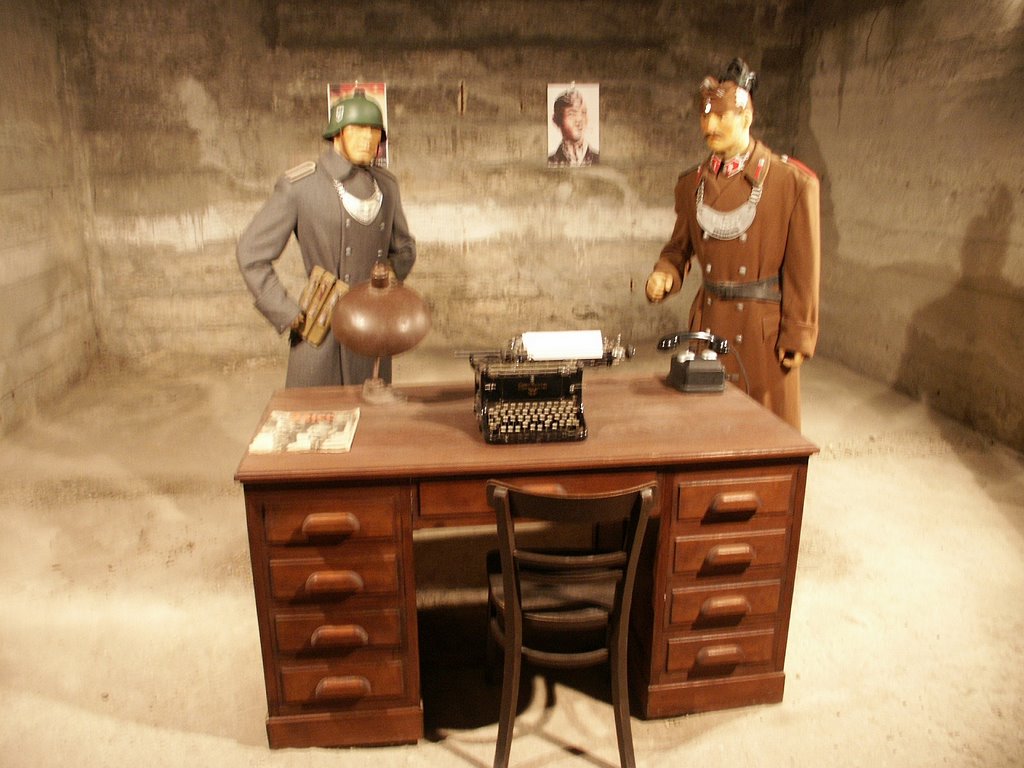
Next, we entered the bunker. This being the shelter and the wax museum, there were separate rooms to view from a hall only with wax representations of the ‘life’ during the war. If you are hawk or a historian, you could stay busy there for an hour or more. It took us fifteen minutes to walk through and take some photos.

The “Memorial park” is a small rounded out area, which I suppose could semantically be called a park with the few flowers and shrubs in the overgrown planted area in the center. Again the history of St. Gellért is told in placards with pictures behind store front windows. Reading the explanations about the two folklore tales of his life, one being in the 1000s and the other placing him in the 1500s, there is not much to be impressed with.

If one were motivated, you could take a stairway down by the base of the statue for yet more store windows with still more displays that look as enthusiastically enticing as the rest. We decided to forsake this opportunity for more exercise. By now, Ron was getting anxious about being home in time for our guests; he took off for home and I continued on, merrily snapping pictures. The statue at the top looks just as impressive from the free viewing area, 15 feet below where I was standing, but shoot, I had paid to get in. I was going to get my money’s worth. The cityscapes were giving me chills of excitement. It was incredibly beautiful to see the whole city from here.

As I was leaving the area, I realized that what was meant by the Budapest 1850-1945 photo exhibit was in the free area. There are large billboard type photos with inserts showing various sights of the city in different years within the range stated. Was it worth the 1,200 Huf for the museums? Well, the photo exhibit was worth the 5 Euro charge, but this is a temporary exhibit. I would not pay it again unless there was another exceptional exhibit in the hotel. The view can be seen for free not that much farther down to make a difference.

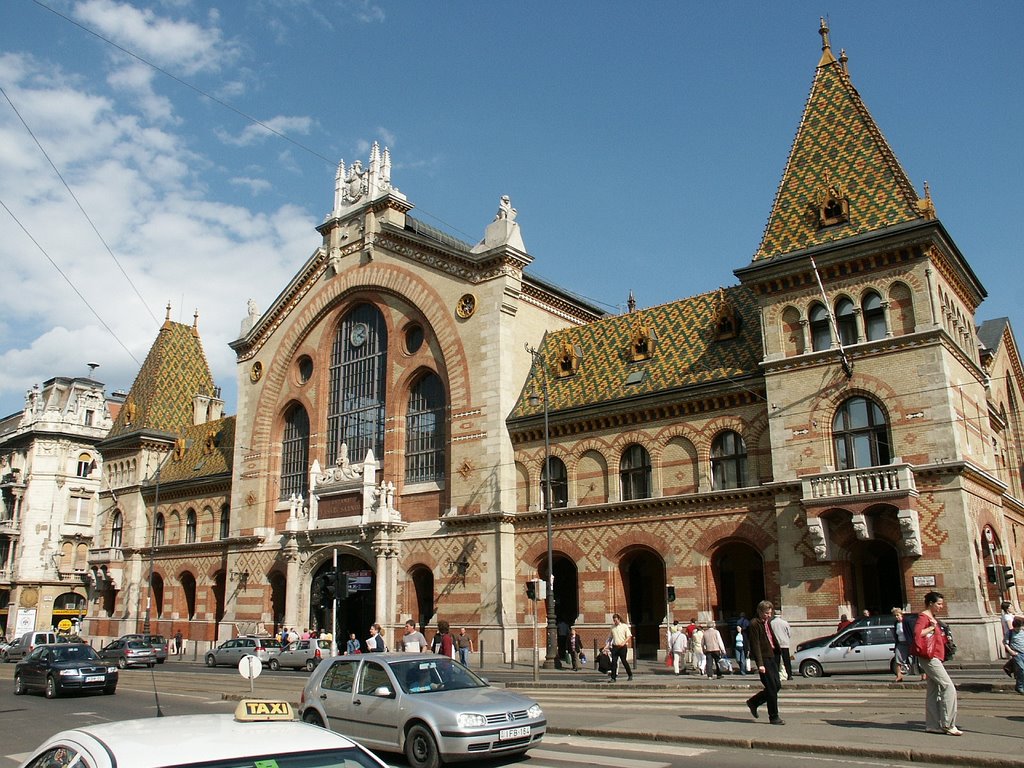
Taking the back way down, I walked the trail to the Rudas thermals and took the bus to the Gellért Hotel for a picture. From there, I hopped on the 49 tram to the Great Market to wander around a bit. Realizing how often I recommend to guests that they get a langos in the market, I thought I had better do some quality assurance testing.

For the uninitiated, a langos is the Hungarian version of fried dough, but with a difference. My favorite is with shredded cheese, ham, and garlic juice. When you go up the escalator to the second floor, there is a restaurant. By-pass this and follow the food stands along the one wall. At the end of the row of food stands is the only one that sells langos. The market being a tourist attraction, the langos stand has gone commercial with ‘Mexican’, ‘Italian’ and other nationality type langos toppings, but to be assured of a cultural experience, get the type that I get or one with sour cream and shredded cheese. They are delicious, but do not plan on eating again for four hours; they are filling.
Reblog this post [with Zemanta]

Pin It Now!

Saturday, May 13, 2006

Contradictions

0 comments

This is not my idea on how to start a day, but our delightful guests chose to go to the House of Terror Museum the first thing this morning. Perhaps it is best to confront these issues early, by allowing the balance of the day’s events to cleanse one’s soul yet again.

This lovely Neo-Renaissance mansion that was built in 1880 was the home to two tragic organizations. The Arrow Cross, which was the Hungarian ultra-conservative party, occupied it from 1940, using it as their headquarters and prison. The Soviets continued the horrors here after their invasion and continued to use it for communist political police activities and prison. The basement contained a torture chamber. "The Public Foundation for the Research of Central and East European History and Society" purchased the building with the intention of creating a museum to remind people of the shocking events in these two eras of Hungarian history. That was in December 2000.

Since this time, there have been various demonstrations protesting the museum and its roof ledge sign, which
has House of Terror in cut out letters overhanging the street. Many residents do not believe the events that took place here should be memorialized for the public and tourists to witness. Most of the protestors are family members of victims of those tortured here. Patricia is still questioning how beauty managed to survive and reemerge after all the dreadfulness that has taken place here. Don lamented upon leaving was that this left no hope for the morality of the human race. “People are capable of great barbarity; however, the lawns, parks, and people holding hands are contradictions that are too great to comprehend.”

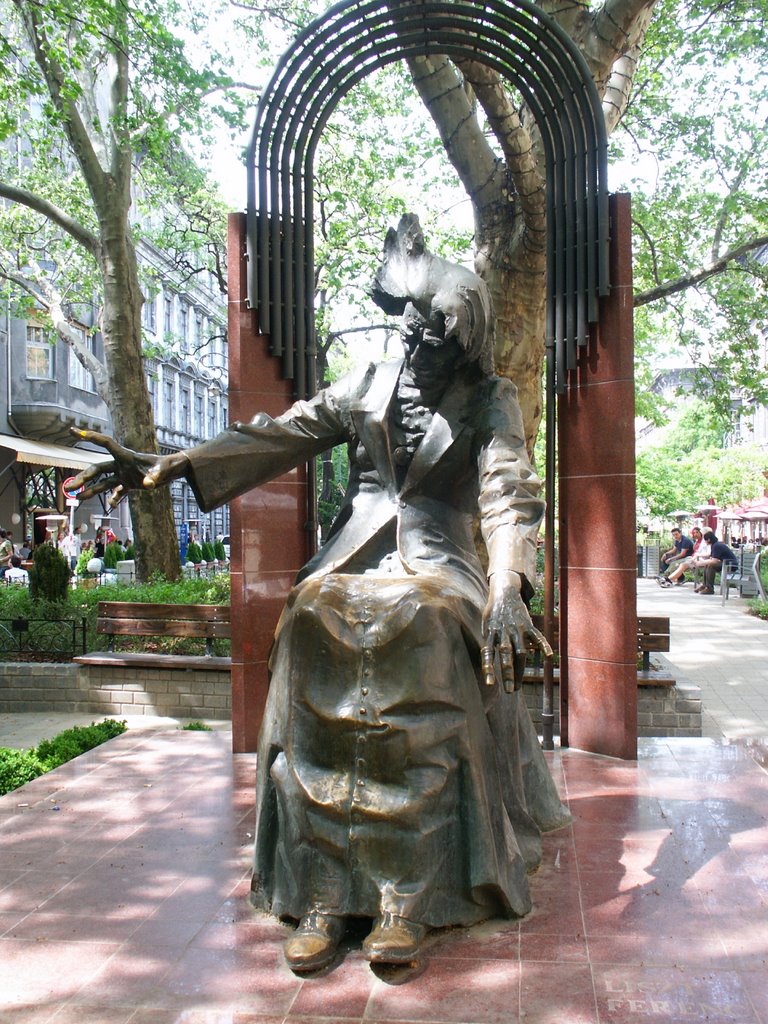
To renew the feelings of humanness, they went to City Park to find the Saturday flea market, but did not succeed. The green space, the people enjoying each other and their surroundings were enough. From here, they went to meet Ron at Liszt Ferenc ter where he directed them to another of our favorite eateries,
Falafel at Paulay Ede u. 53. This vegetarian salad bar has a fixed price for a small or large bowl where you serve yourself from the salad bar. Don and Patricia bought theirs to go, so when I met up with them, we took our goodies to the green space at Liszt Ferenc ter in a quasi-picnic. When I walked around taking pictures, there was a little boy who insisted I take his picture, so I did. His grandpa said he loved modeling for the camera.

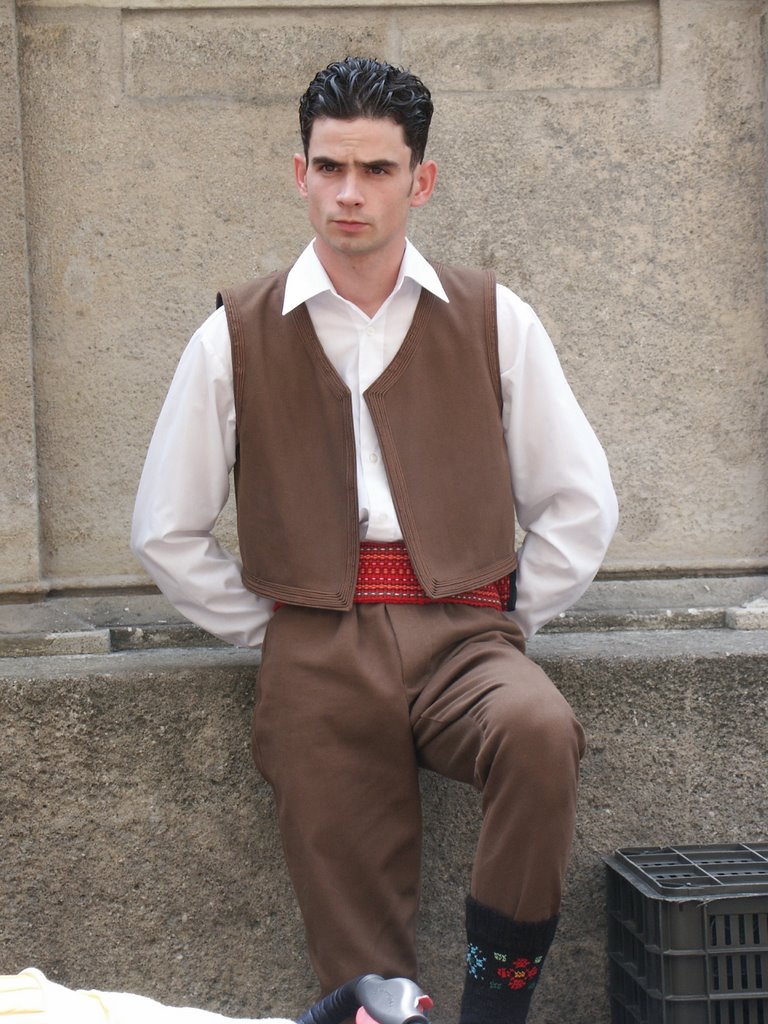
Fortunately for us, there was a district fair today, so on our way to the tram, we side-tracked there. There were booths selling crafts and food, while on stage, there was entertainment. The highlight was the young dancers performing folk dances. Patricia found some whimsical shirts for their children too.

With the tram out of service (until May 19th in one direction), we started in the direction of the tram bus replacement to Nygati train station, but first we stopped for tea at my favorite cafés, Bog’Art. Bog'art Café is at Terez korut 9. What I love about it is it being a combination café with an artists’ collective. One is always charmed by the selections of art as they embrace you while sipping your drink. There are more art pieces both upstairs and down, so be sure to see it all. No food is served, but the atmosphere is delightful. Patricia said this was her favorite of all cafés we had visited.

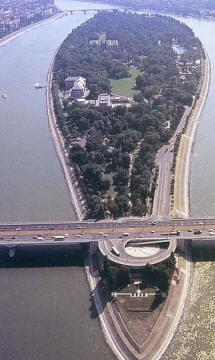
Making our way to Nygati, we took the 26 bus to the island. In the middle ages, cloisters were built what was then called ‘Rabbits' Island’. The name was later changed in honor of St. Margaret. Margaret was a daughter of King Béla IV. She joined a nunnery on the island of which there are still ruins left in evidence. To reach the island you can take the Árpád Bridge from the north or Margaret Bridge from the south, each connecting Margaret Island with the city. The island is 2.5 km (1.4 miles) long, 500 meters (550 yards) wide, spreading out over 225 acres. In the early 19th century, royal families living in Buda transformed this island into a tremendous garden. Unlike other islands in large cities, this island has never been built over, but remains a great park in the city. Due to its healing springs, it housed a health resort that was built at the beginning of the 20th century.

All four of us were spiritually renewed by the greenery, the flowers, but most of all by the people enjoying their freedom. People all over the park were playing, sunbathing, reading, relaxing, and just being. Patricia, Ron and I chatted while sitting on the grass, while Don wandered taking fascinating photos of the people around us. We continued on for a beer at the hotel restaurant and then started back to the bus to come home. Don could not comprehend how at one time this island was victimized by war with tank tracks, yet now it was lush with harmonious happenings. The contradictions again are difficult to sort out.

As we were walking to the bus, we were approached by six maidens in t-shirts, five of which were marked with the word “Sale” and one with the word “Sold”. The lovely young woman who was claiming herself sold explained that this was her ‘Hen’ party and she had to sell parsley for blessing in her book. Minutes later, Ron realized why we had been singled out. One of her entourage was a former student of his from the university. So the bride-to-be gave us a small handmade book and asked each of us to write a blessing in it for her marriage to Péter, her intended. The delightful little book was cleverly decorated on each page with pictures and cartoons of matrimony and parenting. We each gave her our ‘blessing’ and received a small bouquet of parley as a thank you. The nuptial will take place next Saturday, so we will have to remember her. Dori and Péter, may you have a long and healthy life together.

The addendum to this is the obvious admiration that Ron’s former student had for him. She was so proud to tell him about her post-graduate position with the botany department of the Budapest Zoo. She gave him her professional business card and asked that he call her when visiting. From her demeanor, it was apparent that she held him in high esteem as her instructor, appreciating his warmth and caring.

On our way home, we detoured to one of our favorite restaurants for dinner, Szeraj Turkish Restaurant at the corner of Szent Istvan korut and Honved u. is a buffet style, inexpensive taste treat. We were lucky to snatch an outside table where we could chatter about the day and watch the world go by at the same time. Don made an interesting observation that this city is like a pack of cards that were taken apart and then put back together again just as they were with the city being rebuilt paving stone by paving stone, put back in its place.

Don wanted to experience a garden pub. Ron had hunted down an address for one on Kiraly. Some garden pubs are created by squatters. They find an empty courtyard of an used building and open a pub until they are evicted. The addresses change, but the tradition continues. The one we ventured to was not outdoors, but well off of the street down an alley. There were dozens of young people, drinking, talking, playing ping pong and other table games. The rules of the house are that you can sing or perform with the mike for 15 minutes at a time. We stayed long enough for Don to photograph the surroundings and then when home for our nightly ritual of halva and strawberries.

Patricia signed our guest book a couple of days before leaving us. She drew a little picture and placed it inside as well. Her entry:

Very dear Ron and Ryan,

I love our evening ritual (after the day of exploring Budapest) of eating fresh strawberries with halva and drinking tea.
(There is a picture here of three mugs, one tea cup and a plate with berries and halva.)

How will we return to normal working lives after these glorious days of Spring in Budapest?

Thank you for your warmth and care; for sharing your wonderful home; for taking us to the ballet, opera, holy mass, the island, Falafel feast, promenade, Govinda, Parliament, reading rooms, etc…

Thank you for your excellent friendship, which we treasure.

Best love, Patricia

The question in our minds, Ron and I, is how will we return to our normal lives after such a celebrated week that we have shared with such magnificent people?The lines in the picture are due to my scanner.

Reblog this post [with Zemanta]

Pin It Now!

Wednesday, May 10, 2006

The South Africans' First Full Day

1 comments

Well I am following the adventures of the South Africans, via their tales when they return back to our flat. For some of the things, I would like to join them, but these are my last weeks of teachings, so I cannot.

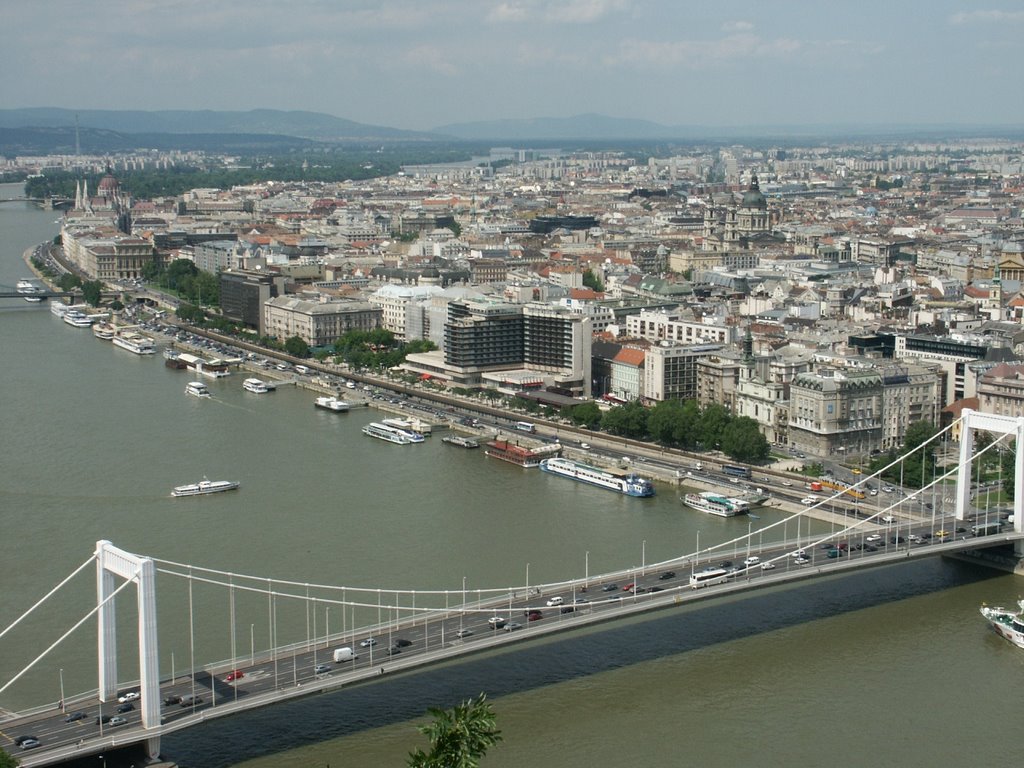
On their first full day here, they went to the Citadel, the high point of Budapest on the Buda side. There you will find a white-stoned fortress from the 19th century. The fortress was built in 1851 by the Austrians to symbolize their dominance over Hungary after the 1848-49 Revolution and War of Independence. It sits on top of Gellért Hill where the 14 meter tall Liberation Monument is placed, a striking statue of a woman holding a palm leaf of victory, can be seen from most points along the Danube. The Russians placed the monument in 1947. The panorama of the entire city is spectacular from this viewing point.

There is a museum and an exhibit hall where they found a photographic exhibit. The theme was Children of War Around the World, not the most cheerful topic, but Patricia in particular was moved to tears with the theme as well as the beauty of the art.

After breathing in the fresh air of the higher altitude, they hiked back down the hill. This would be my preference too as once we did not realize there was a bus going up and hiked up. Half way up I was ready for oxygen, but at the top, I would have welcomed a Respiratory Therapist. The mistakes you make that you can share with guests are immeasurable.

Almost back down to street level, they stopped at the Church in the Cave before hopping on a tram to take the cogwheel for a ride. They had intended to ride the Children’s Railroad, but it was not operating yet.

Returning from there, they followed the Danube to the funicular taking them up to Castle Hill. They found their way into the National Museum where they spent the rest of their day. They were impressed with the number of huge paintings of Hungarian origin by artists, so few in the world have ever heard about. Patricia is hinting she may have to return for more time there.

When they returned there, they found the little co-op grocery store sufficient for their needs to assemble a dinner in our kitchen. We did this side by side and then ate together. We point out the five supermarkets within two blocks of our flat, but they appreciated buying from a co-op as opposed to a supermarket chain.

In the evening, we had an engagement to meet a Fulbright Scholar, a Professor of Nursing and her husband, for coffee. We invited Don and Patricia along to the Central Coffee House, one of the historic coffee houses in the city. The six of us had a lively and lovely conversation until 10:00 pm and then shared a bus part of the way with Beth and Bob before they got off at their stop.
On a personal note, this was the last full week of teaching. Next week is the last. I am so going to miss my sophomore students. They have been exceptional and I have appreciated spending time with them for the last four semesters. All of them have turned into exceptional writers and thinkers. This semester they had embraced the course with gusto, which adds to my being proud of them since I had suggested doing some ‘innovative things’ with them last semester for this semester and they were willing to be my ‘test case’. They not only met my expectations, but far surpassed them, setting the bar at a new level for those that follow.

While I am being the proud teacher, one of my former students who is now in the US on a scholarship, just had an article published in English Teaching Forum magazine, volume 44, number 1 - 2006. She wrote this as an assignment for my class and the secondary part of the assignment was to try to get it published. She and some others succeeded, but hers is the first to appear in print. This magazine is distributed to over 80 countries through the US Embassy.


Reblog this post [with Zemanta]

Pin It Now!