Showing posts with label Otavalo. Show all posts

Thursday, April 02, 2015

And Now the Last Musings on People in Otavalo

0 comments

In addition to things that really impressed us, I have to speak to the people that inspired us. On our first evening, we went to see if the tourism office was open. Right outside the office was this young boy stacking things in a box. At first, I did not pay much attention, but when taking a second look, I realized he was packing away the unsold stock of the day. There were other boxes on the ground that he completed already. Shortly after, a car pulled up where the boxes were placed in the trunk. It made me aware once again how early the children here become working members of the family.

I had read an article in some US newspaper regarding Ecuadorian immigrants to the US. It mentioned there was a
large group in the Minneapolis – St. Paul area. What was interesting was the fact that the reporter claimed that it is well known Ecuadorians have excellent work ethics; they can find a job the day after they arrive. The article continued to mention that employers have come to know that they will get more than a day’s pay from a day’s work with an Ecuadorian employee, hence making them sought after. Here in Ecuador, it seems they will do anything possible to succeed, regardless of how menial the task. I cannot speak to their success or failure, but the point is they try.


People of all ages are continually carrying packages around.
In Otavalo in particular, the average person is short. They are to short that if they were to kiss me on the lips, I would have to get on my knees first, while they still reached up on their tippy toes. This makes me wonder how their backs survive the weight of carrying things all the time. I question whether being short has been an advantage for some reason. Some backpacks are larger than the height of the person carrying it. This is similar to the ratio with
an ant that is carting off food. It is also apparent that the women in particular carry their babies on their backs for a number of years. Is this back strength development?
 

Being a culture junkie, I am acutely aware of how the indigenous people maintain their culture in a fast changing world. What warmed my heart was to see small girls wearing the same traditional blouse and skirt as their female relatives. There is a concession though. 
 A number of young people have smartphones. This seemed incongruent with the customs, until I read this article based in the US. It could be similar circumstances in Otavalo and other parts of South America in general. 

Loja wants to claim the title of Music and Art Capital of Ecuador, but personally, I believe this is a marketing ploy. We have discovered more art galleries, artist venues, and musical events in other cities and towns then we did in Loja. Our first night, we went to the central square where there was a concert and dance entertaining the masses. A few days later, when I needed my
 
Daily Grind coffee fix, we discovered a band playing on the plaza of the central park. The man at the tourism office told us there was a daily music event in front of the cathedral, but the times varied. We were especially pleased to see the female members of the band; this was an equal opportunity career.


This brings me to an observation I have made, though I do not know if stats will support it. From my looking around, I would guess that the baby population is 7:1 girls to boys. 

Finally, the artistic talent is ubiquitous. Not only is it evident in the crafts, art galleries, museums, but more blatant is the street art. We have discovered some fabulous murals on walls that could qualify as a gallery if not museum piece, yet it is
covering a concrete wall. There are two ways to think about this. In one respect, being public art gives the mural a wider audience who can see and appreciate it. Alternatively, it is exposed to the elements, in some cases severely limiting its value as the paint becomes faded, chipped or the wall demolished all together. Overall, I feel privileged to have had the opportunity to appreciate them at this time. 

Pin It Now!

Tuesday, March 31, 2015

Otavalo Street Lamps

0 comments

More than a few years ago, I became intrigued with lampposts. Something made me aware of the artistic value that has to be engaged in order to create these public pieces of art. Yet the artist is an unsung hero when the work excels.

Here in Otavalo, on only a couple of streets, they have really surpassed using lampposts as an art form. I photographed these two years ago and never forgot them. This time, I photographed them again, hopefully 'in a better light'. Only two designs have been added over the last two years; they are the mask and a large red flame with gold cross on top.

Strangely, these two designs are on one street, a different street from the rest. I did not photograph the flame, because I did not appreciate its simplistic design.Regrettably, all of the mask lampposts were in areas obstructed by telephone wires, making it difficult to get a clear shot.

Regardless, the artist(s) should be celebrated if only here.


Pin It Now!

Monday, March 30, 2015

Oh, Otavalo We Are Happy to Return

0 comments

It is easy to become slothful in Otavalo. Maybe this is why I wanted to return here. We spent a few days here two years ago. Back then, we went to the condor area, the national park, and all the nature things that are in the surrounding area. I then fell in love with the town; it is too small with only 50,000 people, to be called a city. Being renown all over South America for having the largest craft market, it is especially enviable on Saturdays. Saturday is the superlative day to visit here as the market explodes covering the entire downtown area. It is possible to buy indigenous clothes to souvenirs, to USB sticks and batteries. Your heart’s desires can be quenched easily and usually inexpensively. 

There is only one museum and this is tiny and privately owned. We did not bother, as the looks of it did not entice us to pay $3 each. This city prompts you to take a deep breath and then release all of the tensions from your body. Slow down, you do not need to rush. Take in your surroundings and enjoy. 

Of course, we arrived late on Saturday; the markets were closing for the day. For me, the markets are a major draw, but not for buying things. What appeals to me are the people watching opportunities. Otavalo is famous for its indigenous population; the group is called Otavalos. They have a
distinctive way of dressing that distinguishes them from other indigenous groups one passes on the streets in other towns and cities in Ecuador. 

For men, the traditional dress includes white pants, which always have sharp creases in the legs, looking like they just emerged from a dry
cleaner’s pressing machine. Regardless of the weather, they cover their shirts with a poncho, most are dark in color. Many wear various types of hats, but always with broad brims. 

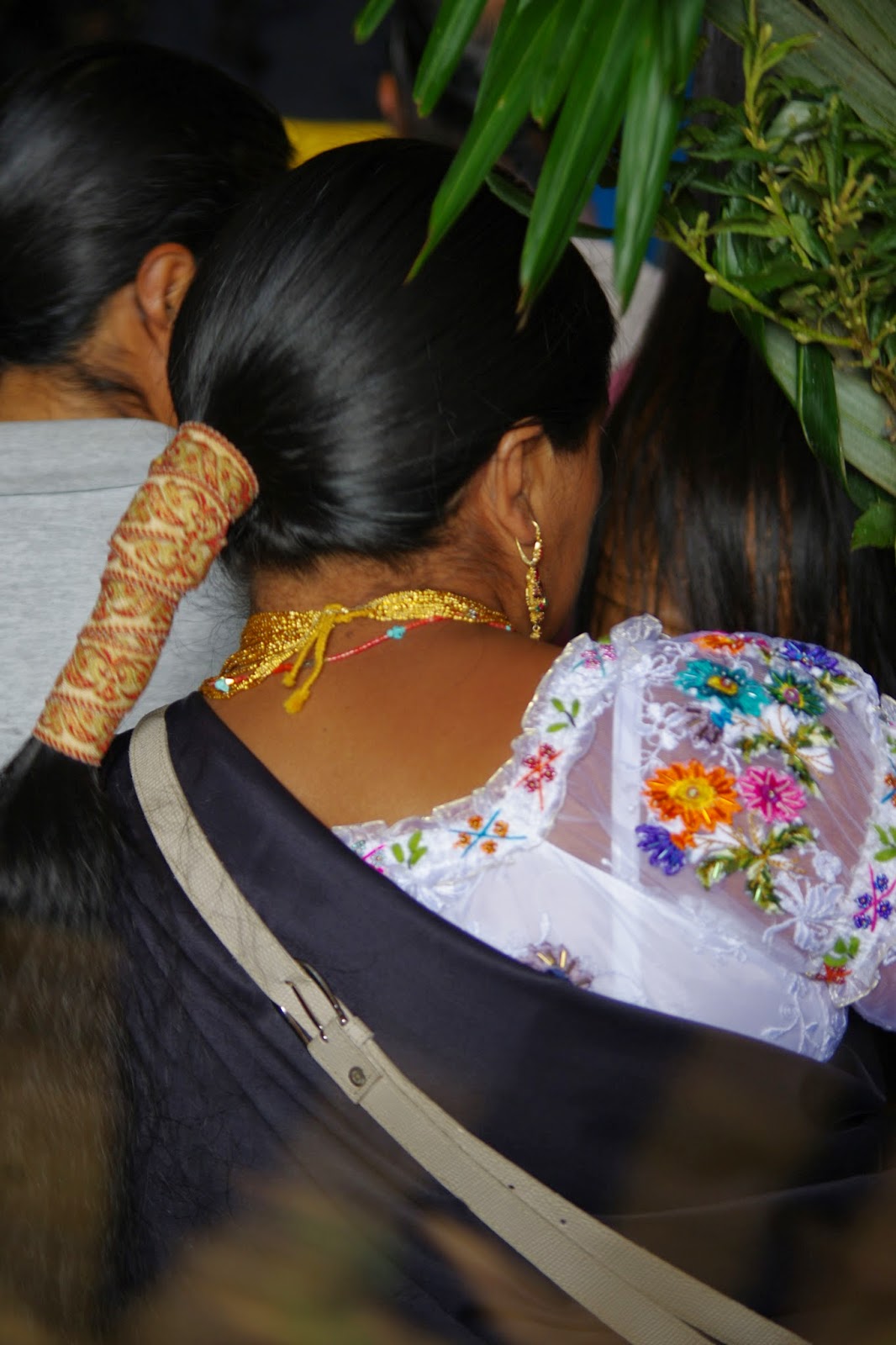
Women wear dark colored skirts usually black or navy blue with a white blouse covered
with colorful embroidery. For a belt, they have equally colorful embroidered waistbands that wrap around and then tie. Women carry their babies on their back using a large white sheet that resembles an over-sized diaper. The baby is tucked in and the cloth is wrapped around her waist to hold it in place. We have never once seen a baby fall loose.

Both men and women wear their thick pitch-black hair very long and in a single braid. The majority of both men and women wear simple sandal like shoes. You can see an example in the photo of the two men. These only come in white or black. Some of both sexes wrap their braid in another colorful embroidered strip of material. 


The Otavalos are considered to be the most successful group of indigenous in Ecuador as they sell their craft work worldwide. An equal mix of those who made their riches as those who live in poverty, exist here.

We went to dinner at Buena Vista, a restaurant overlooking the famous Plaza de Ponchos. This is the location of the daily craft market. Our pleasant experiences with the restaurant lingered from our last visit, so we returned. We were not disappointed. After dinner, we walked to the central square. There was musical entertainment, speeches, and dancing. It is gratifying to watch the crowds of locals swell taking in the free entertainment. 


Sunday was Palm Sunday. As it turned out, it was a major cultural event. The palm leaves they used here differ from the palms distributed in the US Catholic churches. Woven palm leaves create vases, which they fill with
other greens. We never did figure out what the greens were. These vases sell for $1 already filled.

The town was buzzing with people carrying their vases. When we went into the church, Ron had missed the mass with no other following it. The entire altar was covered with a huge purple sheet. We had no clue as to what this was about. 

I do not need to shop to love Otavalo. The studio apartment we rented is excellent. There is enough space to feel like multiple rooms, though it is only one. It is quiet and the bed is superior. I love getting into it and hate getting out.

Pin It Now!

Friday, January 04, 2013

South Plazas and Santa Fe Islands

0 comments


South Plazas Island
6:30 Breakfast
7:15 Dry Landing – 
closed shoes, rocky trail, hybrid iguanas
9:45 Back on boat > sailing

Santa Fe Island
12:00 Lunch
1:30 Snorkeling
3:00 Back on board
3:30 Wet landing – closed shoes, rocky trail, Giant cactus forest, land iguana expedition 
5:30 Back on board
6:30 Dinner
Briefing for tomorrow

Waking at 6 am to get ready for breakfast was a no-brainer. At 4:30, we could hear the anchor being lowered; it is right near our room. Asking others, it was just as apparent for them as they have lower berths. The chains passing by on the way to the sea have nothing on the ghostly rattling of chains sounds in a haunted house.  

Meals are buffet style. Breakfast held choices for fried eggs, bread, pineapple, cantaloupe, and two types of cereals to gear us up for the day. Buffets can mean trouble, but it looks like this crowd is well aware that everyone needs to get through the line before returning for seconds. 

 Our dry landing meant that we were to take the dinghy from the boat, but land at a dock once at the island. As soon as we approached, it was apparent that some sea lions were using the dock for sunning themselves causing us to share the space. Sea lions are ubiquitous and this being a government park the rules are to stay 6 feet away whenever possible. On the rocks are red crabs with blue backs; the contrast is quite beautiful. Large cacti in numerous configurations spread out over the landscape like an old western movie, but they are accompanied by a low growing plant called something like carpet wheat. We were not sure if the guide was saying carpet or copper. Regardless, in the rainy season, it turns green, letting the land iguanas know their meal has been served; it is filled with water. During the dry season, the red color shows there is no moisture so don’t bother to nibble. 

We were given a number of lessons regarding the different types of rocks on the island including their formation, none of which I care to repeat here mostly because I could not take notes, so don’t remember. As we were seeing different birds and having them identified, my camera batteries had given out. I had bought 2 sets of 4 Eveready batteries in Otavalo and had them with me in case. None of them worked after multiple attempts, making me furiously fretting over the Kodak moments that were passing me by never to be captured again. Just by pure chance, I put my rechargeable batteries in once again; though I knew that I had already really squeezed the juice out of them. It worked just as we spotted our first Blue Footed Booby and I was able to shoot him amicably. 

Dozens of land iguanas posed for our cameras; here they are the brown or golden colored ones in the pictures. The marine iguanas are black and dive into the sea for their food, then climb the rocking walls to return to shore. Marine iguanas are smaller than their land cousins, living only about 40 years, where the others have a lifespan of 50-60 if no hawk makes lunch of them. We were told we would see marine iguanas on another island on another day.

On our return to the dinghy, I was able to capture a baby seal nursing from its mother. They were right on the dock, making it easier and both appreciated that the capture was on the camera only. This was the end of the morning’s excursion, back to the boat we went.

The afternoon snorkeling was a disaster for me. We were taken by dinghy out a ways and dropped into the water to return to the shore. Because we cannot all fit on the dinghy, it was returning for the rest, returning with a ladder to climb back into the dinghy if anyone became tired. After about ten minutes, Ron was tired and signaled for the dinghy before its round trip for the ladder. This panicked me, worried about him and then I could not breathe. From that point on, I had difficulty breathing with the snorkel; forty plus years of smoking taking their toll. They had to drag me onto the boat like an oversized tuna. Captain Ahab had it easier. Humiliation set in. Thankfully, there was a young Finn guy who did not snorkel at all, because he was not a good swimmer, so I had company when Ron jumped back in the water. 

This afternoon, we had a great outing on trails where there were dozens of sea lions, land iguanas of a different variety than we saw in the morning, and lots of birds. The cactus on this island grows like big trees, to keep the iguanas from eating its spiny pads until they fall to the ground. If there were turtles on the island, the pads would be even higher since turtles can climb on their back legs and stretch their necks to reach farther. I was able to get some fun videos of the sea lions here and great pictures of pelicans. 

As we were getting ready to leave the island, Ron spotted a guy that was at Hostel Joshua with us in Guayaquil. Ron said he was on the same plane with us, but I don’t recall seeing him.

Dinner was pizza, cabbage salad, zucchini in a sauce and chocolate mousse for dessert. When I refused the dessert, he gave me fruit instead. Most of us sat around the lounge on the main deck or the smokers went to the smoking area on the upper deck open to the sky. With the early mornings, the rocking boat, and a sense of peace, we retire much earlier than normal to read and then doze off.


Enhanced by Zemanta

Pin It Now!

Tuesday, December 25, 2012

Otavalo Photos Part 2 of 2

0 comments

Part 2 of 2 of the Otavalo photos are here.

Pin It Now!

Monday, December 24, 2012

Cristmas Eve - What Again?

0 comments

Returning to Quito has been stimulation let down. In Otavalo, there were Christmas decorations in the public squares, on the streets, in just about every store and hotel. In Quito, you are hard pressed to find anything festive at all. In one square, there are some white lights strung on a few trees that look like the way I used to put tinsel on the Christmas tree I got tired of being careful. They are just flung on without regard to symmetry or appeal. Stores are crowded as it is so why bother putting up decorations when people are coming in anyway. Only churches have some sense of style, but one crèche after another is not my idea of fun.

Adding to my misery, I cannot get a real latte coffee. It is the strangest thing, but each time I ask for a latte, I get regular coffee with hot milk separately or mixed, more commonly called café au lait. Describing in minute detail exactly what I want as I am practically climbing over the counter to demonstrate with their espresso machine, I get something different. Sometimes it is a demitasse espresso with milk in it or a demitasse espresso with no cow juice in sight. Where or where is The Daily Grind? Oh, yea! It is in Otavalo. Well here there is The Magic Bean, but that is in the new part of town, eight dangerous bus stops away, but it may be worth the trip.

It is Christmas Eve. It is raining. It is cold. I spot an espresso machine at the San Francisco Church gift shop and restaurant.  Hope is eternal. First we check out the gift shop; we want to approach this slowly and not scare off the barista. This is not a gift shop, it is a museum where everything is for sale. It goes on and on in this maze like fashion. Ron jokingly suggests I leave a trail of breadcrumbs so that I don’t get lost. I felt a need to tell him I loved him, Merry Christmas, and hopefully we would see each other again by my birthday in January.  Everything for sale of course was a replica, but beautifully constructed. It took me forty-five minutes to make my way through and find my way out again. We ordered drinks at the gift shop restaurant. Again, I was disappointed. The coffee tasted like they used pig sty mud to filter it.

There is no place to eat dinner at a reasonable hour. All restaurants are closing at 5pm. Not even the fast food restaurants are staying open beyond 5pm. We went to one place we had queried earlier and arrived at 4:20 pm, a bit early for dinner. They refused us, because we could not be done by 5pm.  We ducked into a close by fast food restaurant before they locked the doors. It is tough choosing a Christmas Eve dinner from a fast food menu, but dozens were doing it and I would bet many have diseases they don’t even know about yet.

Five o’clock in the evening, the streets were still mobbed with people. This is your big holiday. Get the hell home and cook dinner. Finish wrapping presents. Do something Christmasy, AT HOME! By 6pm, the streets were empty. They took my advice. We decided on 8pm Christmas mass. The only reason I go is because my heart would be in my mouth letting Ron go by himself. It is not confirmed, but the latest Christmas mass held at any of the 5 churches downtown is 9pm. I think that the police staff starts to thin out by 10pm, so for safety sake, they do it earlier and get it over with. It also gives all of the priests’ time to prepare milk and cookies for Santa.


Ron of course wanted to be at church by 7:15 to get a seat. Our church of choice or rather his was La Compañía de Jesús. I delayed us until 7:30 to reduce my agony. It was a joke. We had our pick of seats barring maybe 3 rows of pews. Long after I gave up wishing I had brought my book to read, the church was less than half full. Here is this church that is bleeding gold everywhere you look. They took up only one collection. By the time the basket reaches us, a quick perusal of the contents assures me it would not pay for a nice dinner at a semi-expensive restaurant. No fear of priestly embezzlement here unless they chip some gold from some hidden place. Even the wall sockets are gold.

Masses in Latin countries are so different. People are bringing up baby dolls with fire points coming out of his head. This is their Jesus from their crèche. They put these dolls and other items on a table to be blessed after mass. During mass, children are running around. People are staring with admiring eyes at the darlings, barely recognizing the fact that there is a priest up there doing something holy. Those who don’t belong to the child enjoyment society are busy speaking amongst themselves.

This is why I leave home for Christmas. I want the pomp and circumstance of other cultures to glide me through the holiday. It saves on sweeping up tree needles and repacking ornaments myself.

Enhanced by Zemanta

Pin It Now!

Sunday, December 23, 2012

I Left My Heart in Otavalo

0 comments

Leaving Otavalo was an emotional experience. In the few days we have been here, I have come to love it. There is so much positive life energy. Speaking with a couple of Americans who are living here, it is not just Christmas time, this is the norm. This could be an alternative place to live if the correct opportunities surfaced.

We took our last walk around town and low and behold the central square had transformed yet again. Over by where the dance performances were held the night before last, the bleachers were now gone and the Ecuadorian version of Jack Lalanne was doing a public class in aerobic exercise with a vast following of the public matching his every move in tandem. Just watching them exercise non-stop for over a half hour made me tired, but they did not end it there. They continued on as we moseyed on over to The Daily Grind for a coffee.

There we met an American from NYC who supposed has a non-profit foundation to build schools and then turn them over to the community. She was believable at first, but as her story became increasing aggrandizing while at the same time contradictory to what more than one Ecuadorian has shared with us, I started to be skeptical. After 30 minutes of listening, I asked her if she know of the US State department resources that could be tapped into. She knew nothing about them, which I found strange for someone running a foundation for over 10 years.

Checking out of the hotel brought a small surprise. Although we had paid for the room ahead of time in full, breakfast was not included as we had read in Frommer’s nor as it turned out was it $3.60 a day per person as our Booking.com reservation showed. It was $4.40 per person each morning, depleting our cash reserve by $35.20.  

Grabbing a taxi from the street is extraordinarily easy. The young man took us right to the bus that was leaving for Quito for only $2. Being the first to arrive, we had our pick of seats; hence the very front offered the most leg room. These buses like most in Central and South America stop anywhere along the street where some flags them or someone alerts them of the need to get off. Every bus has a person, usually, but not always a young man who hangs out the open door yelling the route along the way as the bus approaches any single or group of persons on the roadside, giving them time to hail the bus if this is their destination. Although the roads are well maintained, there are still some bumps, so my heart was in my mouth expecting this man to go flying through the door at any time.

From the Quito bus station to our hotel, which was farther away than our last hotel here, the cab ride only cost us $10.00 whereas going it was $15 and to the wrong bus station at that. We were so pleased with the rate as the poor driver kept his patience as we were stuck in traffic for over a half hour at times, less at other times, but it was repeatedly. It kept me thinking I was so delighted that taxis are not metered or the bill would have been over the roof.

Our current hotel is right in the old city. What we failed to remember having used the Hop-on Hop-off bus the last time is that Quito has a tremendous amount of steep hills. I mean to say that Quito makes San Francisco look like the Hungarian Plains. There is one staircase that has about 500 steps from bottom to top with nothing in between where to rest, other than one of the steps. Strangely, even with Quito and Otavalo being the same altitude presumably, we were smacked with low energy within an hour of walking upon our return. There is an entirely new adjustment period needed.

With all of the stores open, the streets are jam packed with pedestrians and cars. We assume people are getting their holiday shopping out of the way, in spite of this being Sunday. This is one of the few times you can visit churches, because they are open for masses. There is a Catholic church about every three blocks in the Old Town area. If you have ever heard of or experienced snow blindness, in these churches imagine gold blindness. In all of the churches I have been in in over 56 countries, I have never seen anything like this before, EVER! Every single inch or centimeter, depending on your choice, is covered with something and that something is either gold or framed in gold. Each time I go into one of these churches, I think King Midas was let loose here after being on souped up amphetamines. There is an unreal feeling to them. I would never be able to concentrate on the service without my eyes roaming all over the walls and ceiling.

In this neck of the woods, we have yet to be able to find a decent place to eat where I can accommodate my eating plan without breaking the bank. Tomorrow being Christmas Eve will be another challenge.

Enhanced by Zemanta

Pin It Now!

Saturday, December 22, 2012

Otavalo Photos Part 1 of 2

0 comments

Pin It Now!

From Lively to Manic

0 comments


This seductive, slow paced city, turns into a manic monster on Saturdays. Famous for its Saturday markets that have become so popular they are now held daily in abbreviated form; however, on Saturday it explodes like confetti being shot from a cannon. Like a manic depressive, the rest of the week seems repressed, depressed, and withdrawn as compared to the manic, nothing is held back, city on amphetamines nature that is its transformation. 

 We could not believe what we were seeing as we left the hotel for the park. There was barely a footpath between booths, stands, and individual sellers walking the narrow transit areas hawking their wares with pushcarts. It was exciting, it was a sensory overload, it was energizing. There were fruits we have not seen before or some that we have not seen in years.

Burdened down with cash, I felt a strong need to unburden myself by shopping. There were little gifts for some friend’s children, some things to embellish the walls of the B and B bedroom walls, and other presents for me alone. Five avocados sell for $1 or a bag of ten mangoes for the same price where 75 cents will buy you a grilled banana or plantain. Some woman sell roasted bugs and in another bowl cooked beans. I was not taking the risk of getting the wrong one so by-passed both.

Basically, this is how we spent our day, being tussled, shoved, stepped on, and pushed out of the way while browsing and shopping. What a fabulous day it was. There were stops at The Daily Grind for a coffee and Buena Vista for lunch. Christmas shows are still being performed in the main square creating a liveliness I have not felt for years.

This being our last night, we decided on Hosteria Country Inn Puerto Lago restaurant out of the town. It sits on a lake overlooking the mountains. We went about 6 pm to be sure to make it before the sun set. Being seated at a table right near the window, the view was incredible watching the clouds dance around the mountains turning color from milky white to orange sherbet.

Quinoa empanadas stuffed with cheese is nothing I would ever have thought of, but they were unbelievably delicious. Ron had a trout in a sauce neither of us was familiar with, while I had curried chicken. My potato was baked, but halved, scooped out and filled with a cheesy cream. Both dishes made impressionable presentations.

Enhanced by Zemanta

Pin It Now!

Friday, December 21, 2012

A Day Tour

0 comments

At 10am, we will meet Luis, our guide for a four hour tour of the surrounding area. Right after breakfast, we ran over to the church in the park a block away, Santuario del Senor de Las Angustias (Sanctuary of the Lord of the Anguishes, Agonies, or Torments…take your pick). Our instincts were correct. There was a children’s mass in progress, but what we had not counted on where the way the children were dressed. There was a wide variety of angels, shepherds, some in Santa type clothes, and assorted other costumes. You can see them in the pictures in the photo blog. They all sat in like groups; all angels were in one spot, and so on.

What fascinated me more was the group of obviously indigenous people right outside the door of the church. With a dark skinned man presiding with the traditional indigenous hat and long braid of black hair down his back, he held a white rose and a can of water. Surrounding him were about 8 women also dressed in indigenous garb, but no other men were in this group. On the ground was a blanket upon which were six books. I tried looking at the titles, but could make them out for certain. What I am sure of is that none of them were bibles. A sedate ceremony took place with the man chanting something, obviously a prayer of sorts. He would stop intermittently to sprinkle the books with the rose after it was dipped in the water. At this point it was the women’s turn to chant. After this cycle took place about 3 times, the gang broke up.  This is the time when I would love to be able to quiz someone about the customs.

By 10am we were back to the hotel and Luis was on time too. His English is negligible and our Spanish is fractured, but we managed fine with both language working back and forth. Our first stop was the Cotacachi Reserve where the path circles an inactive volcano. A lake has been formed in the crated with a couple of isolated islands. Volcanoes don’t come on the ground floor mind you, so when Luis questioned “Do you like to walk?” I interpreted this much differently. What he should have asked is “Do you like to drag your butt up hundreds of stairs?” My answer would have been completely different for sure.

The maximum altitude is 14,832 feet with the minimum being 900 feet. I don’t do the step machine at the gym for good reason, but times like this make me sorry I don’t. To circumvent the entire volcano, which athletic people are apt to do, will take 5 hours. For us less adventurous, we only spent 20 minutes, but I think Luis held out longer. My lungs will swear to it. Besides, he gets paid by the hour, so he had motive to keep up climbing. I gave up earlier than Ron did, because I can say “NO!” in fourteen languages. Ron can use the word with me or tell me he doesn’t want to do something, but feels if he tells the stranger this, it may hurt their feelings. My legs and lungs vs. their feelings? No contest for sure!

Next we went to a town named Peguche, known for its leather goods. This is a major tourist attraction. The streets are lined with one leather store after another for blocks. It is incomprehensible how any of them can make money. The streets were almost completely empty sans a few locals. I think we only saw one other couple that could be pegged as tourists, by their skin color. Luis informed us that a number of US Americans, Italians, and Swiss have relocated to the next town, so this assumption about the tourists could be incorrect.

We stopped for lunch at Tierra Del Sol hotel and restaurant. Considering Luis picked the place, it was a welcome discovery to see the prices were reasonable, the portions too large to finish, and the service excellent. Luis was going to wait outside, but Ron insisted he eat with us as our guest. Upon my request, they made a dish with quinoa and steamed vegetables. It still confounds me that this is one of the major producers of quinoa and other grains, but they are frequently absent from menus in restaurants.
Our third stop was Pinsaqui Hacienda, famous for being 400 years old and having Simón Bolívar sleep there in room number 1 of course. It was interesting, but Luis was so impressed by it we had to continually ooh and ahh for his sake.
As we were closing in on four hours and didn’t want this to run into a $50 tour, we explained to Luis that we had seen enough. He insisted on one more stop, a town named Cotapachi, which was 100% indigenous people who were also known for their handiwork. At his insistence we went to see a weaver. His work was lovely, some I would have loved to have, if we had the wall room, but more importantly if we could get it home. We still have much traveling to do before struggling with airline regulations on weight issues making for a perfect excuse to leave all rugs and weavings behind.

After a coffee at the Daily Grind we headed to the hotel to rest meaning I worked on my pictures while Ron dozed. The call of the wild got to us, so we roamed the streets looking over the vegetables and fruits on offer. Some street vendors sell something that could be mistaken for cooked beans until you look closer where the legs are visible. It is still to be determined what species this was. Bananas grilled are a common offering, so I had one. It was good, dry, but still banana flavored. Almost everywhere you can find some little old lady selling avocados. I bought 5 of them for $1.00, the going rate.

You could tell it was Friday night; droves of young people were populating the streets. Looking for a recommended restaurant, it turned out that now it is a Turkish smoking den for young people. After some serious hunting, we settled for an Italian restaurant run by indigenous people. The chicken and beef lasagna that each of us had were quite different from any before, but was still tasty.

Back in the park near our hotel, there was yet another Christmas festival, but with adult entertainers. There were 2 hosts who talked too much, but intermittently, there were dance and music performances. I managed to video three of the dancing pieces, which are in this blog.

Two last notes, strangely enough you cannot drink the water in Quito. You have to use bottled water for everything including brushing your teeth. In Otavalo, the water is purified and safe to drink and use. 


One lucky break: We were planning on three days in Baños, but since it would have been a 4 hour bus ride, we changed our plans and canceled our hotel there. That same morning, we received a warning from the US Embassy "The U.S. Embassy in Quito advises U.S. citizens living or traveling in Ecuador that the Tungurahua volcano, located near the tourist community of Baños in central Ecuador, continues to exhibit increased seismic activity.  Ecuador’s Geophysical Institute reports ongoing ash discharge, lava flow and explosions."

Enhanced by Zemanta

Pin It Now!

Christmas in Otavalo -3

0 comments

Pin It Now!

Christmas in Otavalo -2

0 comments

Pin It Now!

Christmas in Otavalo -1

0 comments

Pin It Now!

Thursday, December 20, 2012

Ecuador Facts and Thoughts

0 comments

Ecuador’s population is 15,223,680
Quito – formally San Francisco de Quito is the capital city of Ecuador with a population of 1.801 million. It is the 2nd largest city of the country.

Ethnic Makeup:
•    Mestizo (mixed Indigenous and White) 65%
•    Indigenous: 25%
•    Spanish and other European: 7%
•    Black: 3%
There are over 40 indigenous nations including the Quichua, Huaorani, Shuar (Jívaro), Achuar, Cofan, Siona, Secoya, Otavaleño, Tcháchila (Colorados), Zaparo, Salasaca, Canari, Saraguro & Chachi

In Otavalo, it is estimated that 75% of the population are indigenous peoples. Most of the people are so short; they do not come up to our breastbone. When the nursery school performed their concert, they looked like 2 year olds. If you see someone over 5 feet, they really stand out from the crowd. There are some older indigenous women we have mistaken for children until could see their faces.

Languages:
Spanish (official), numerous indigenous tongues. Quichua, the language of the Incas, is the most widely spoken indigenous language and now recognized as an official language.

Weather
If we are so close to the equator, why am I freezing? I had thought that the Southern Hemisphere during their summer would mean warmth. Worthy, but faulty assumption that is, truth be told. Quito’s temperatures are fairly steady with a daytime high of 66 °F (18.9 °C), which generally falls to an average of 50 °F (10 °C) at night. This we learned is basically due to the altitude. In school, we learn that heat rises. One would think that being closer to the sun, we would be warmer. Otavalo, close to the same altitude as Quito, runs a general high of 60.1 °F (15.6°C) with a low of 40°F (4.4 °C) at night. Sure feels colder since the hotels, shops, and restaurants do not have any heaters.

Currency
The country uses the US American dollar and coins, but some of the coins are still the old Ecuadorian. There is a plethora of $1 coins, which strangely enough, they are all with Sacagawea, a coin that never caught the affection of the American people.

Regarding money, no one ever has change. If you try using a $5 bill for something that cost $4.29, they will ask you if you have any smaller bills. If you are trying to use anything over a $10 bill you are not going to be able to complete the sale. Exceptions being for example if you are in a restaurant and your bill is over $20, but even then, they want as close to the exact amount as possible. Some of the high end shops still have to rummage for change to the extent of getting employees to empty their pockets so as not to lose a sale.

Education
We are amazed at the number of schools around both cities. One can barely go three blocks without running into a school of one sort or another. These are not shabby looking schools either. There has not been one school that I would not have minded attending myself. They seem to be putting their money into education through the high schools at a minimum.  We have seen hundreds of students wearing dozens of different uniforms. Asking around, uniforms are required for all schools, even the nursery school kiddies have their own little uniforms.

From what we heard from our tour guide, for university, the first child goes for free. All other children from that family have to pay tuition.

Botany and Exports
Ecuador has over 300 varieties of orchids. Their major exports are petroleum, bananas, cut flowers, shrimp, and gold. They are the world’s largest exporter of bananas.  There are 25,000 species of plants in the country.

Telecommunications
It is rare to see anyone on a mobile phone. They probably are too costly. I did not notice too many Wi-Fi signs in Quito, but in Otavalo, there is free Wi-Fi in all public parks. It is not unusual to see young people in the park with their laptops.

Contradictions
In Otavalo, you can pass by a very high end telecommunications store selling expensive equipment while right outside will be an indigenous women with a blanket spread selling her handicrafts. You can also walk by a supermarket jammed with people, yet there will be indigenous women directly across from the store’s door selling their own produce.

Christmas
Being 95% Catholic, this is country takes Christmas seriously. So far we have seen 7 different little song performances around the city of Otavalo performed by different school groups dressed in matching costumes or with girls dressed as angels and the boys with elves hats on. The streets are strung with lights and many of the shops have a plethora of decorations in the windows.

Of all things to be a Christmas treat, it is animal crackers. We see 50 pound bags of them all over the markets. There are also handfuls of them in Christmas bags with other sweets, like candy bars. These are given to children as a Christmas treat. The animal crackers are labeled zoological galletas.

Children
We get many stares from children. They are not accustomed to seeing a white face or faces with beards. All of the locals are clean shaven, both men and women. I was coming around a corner and the same time a little chubby girl was coming from the other direction. We almost plowed into each other. As she stared up into my face, I just wished I could take a picture with my eyes that was shareable. Her look of awe was incredible and precious at the same time.

Pin It Now!